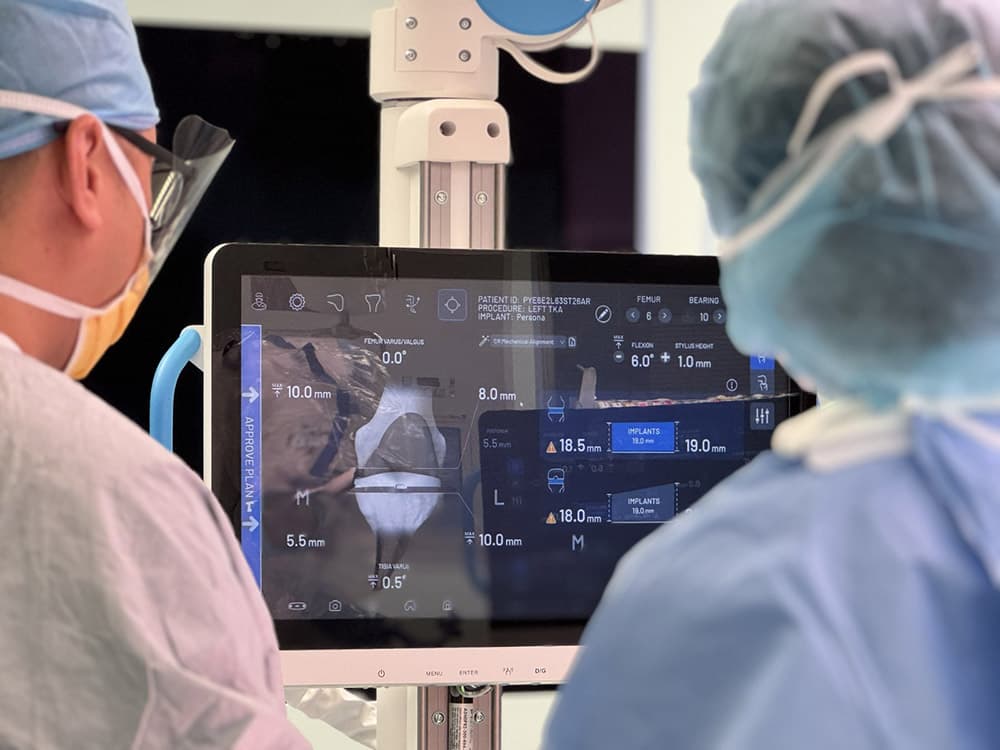
Let’s say your knees have been screaming every time you get up. Or maybe your hip has turned daily walks into a slow, painful shuffle. You’ve tried the usual—physio, meds, rest—but the relief doesn’t last. Someone mentions surgery. Then, you hear two words that stop you in your tracks: robotic-assisted.
A robot doing surgery?
Not quite.
Let’s clear it up.
First Things First: The Robot Isn’t Doing It Alone
There’s no autopilot here, no machines making decisions on their own. It’s your surgeon, a real person, using advanced robotic tools to perform surgery with greater precision than the human hand can achieve alone.
Depending on the robotic system (image-based or imageless), a CT scan may be needed before the procedure. For example, for Stryker makoplasty, a CT scan is done before the procedure. That image becomes a 3D model, custom to your body. During surgery, this digital guide helps your doctor place the implant exactly where it should go. The robotic arm moves only when the surgeon tells it to, and it stays within pre-set boundaries to avoid straying.
There are other systems available—for example Zimmer Rosa, and J&J Velys where no CT scan is required. In these cases, the surgeon may need to do mapping during the procedure to give the robot information about your knee.
It’s like using GPS while driving. You’re still steering. But the system’s there to help you stay on track.
So How Is It Different From Traditional Joint Surgery?
Standard hip or knee replacement is based on measurements taken during the operation itself. Even using standard instrumentation, the procedure is not performed via eyeballing. A system of checks and guides have been put in place, and used for decades, and traditional knee replacements have led to very good outcomes. Experienced surgeons still do excellent work this way, but robotic assistance adds another layer of consistency.
With robotics, there’s a plan (literally mapped out in advance) and a machine helping stick to that plan. It means fewer adjustments mid-procedure, fewer surprises, and in many cases, a more comfortable fit for the new joint.
What Makes Patients Consider Robotic Surgery?
For one, accuracy. More accurate cuts and placements can lead to better balance and joint alignment. That matters a lot. If your implant sits just a few degrees off, it can wear out faster or cause pain when walking.
There’s also recovery. Some patients get back on their feet quicker, with less swelling and less pain. In a study published by the National Library of Medicine, patients with robotic-assisted knee surgery walked farther—sooner—than those who had standard procedures.
In short? When it works well, robotic surgery can feel smoother, during and after.
Are There Downsides?
It’s still surgery. It still comes with risk.
Infection. Bleeding. Nerve damage. These are uncommon, but possible. Just like with traditional methods. And while robotic tools are safe, they do add complexity. If the machine has a glitch (rare, but not impossible), the surgical team will switch back to manual mode. They’re trained for that.
Then there’s the question of access. Not all hospitals in Singapore offer robotic-assisted knee surgery or robotic hip replacement. It may cost more, and your insurance might not fully cover it.
Bottom line: It’s not 100% risk-free. But in the right hands, it can be a helpful tool.
Who’s a Good Fit?
This surgery isn’t for everyone. But it’s worth considering if:
- You have moderate to severe arthritis in your hip or knee
- You haven’t had a previous joint replacement in the same spot
- You’re reasonably healthy and mobile
- You’re looking for a more personalised approach
At Hip & Knee Orthopaedics in Singapore, doctors assess every patient individually. You’ll have scans, a physical exam, and a clear conversation about options. You won’t be pushed into anything.
Sometimes robotic-assisted surgery makes sense. Other times, standard methods are just as effective. The goal isn’t to use fancy tools for the sake of it. It’s to get you walking comfortably again.
What the Process Looks Like
Step 1: Planning
If the system being used requires preoperative CT scan, you’ll get a CT scan of your hip or knee. That’s sent to a computer system that builds a 3D model of your joint. The surgeon then maps out where your implant should go, down to the millimetre.
Step 2: Surgery
On the day of the operation, the robot is brought in. The surgeon still does all the key steps. The machine just helps follow the plan closely. Think of it as a smart guide, making sure every cut is on target.
Step 3: Recovery
Most people stay in the hospital for 2–3 days. You’ll start moving with help the next day, sometimes the same day. Physio is crucial. At first, it’s just getting up and walking. Gradually, you’ll build strength and stability. Many people feel steadier and more confident in just a few weeks.
Full recovery takes a few months. That’s normal.
Does It Last Longer?
That’s the hope. If your implant is placed more precisely, there’s a better chance it’ll hold up over time. Early data shows promising results, but to be fair, robotic-assisted joint surgery is still relatively new. We’ll know more in 10–15 years. For now, most signs point to better alignment and potentially fewer revision surgeries down the road.
Why Patients Choose Hip & Knee Orthopaedics
At Hip & Knee Orthopaedics in Singapore, our surgeons are trained in both robotic and traditional methods. That means we choose what works best for you, not what’s trending. You’ll be heard, informed, and supported—whatever you decide.
And if surgery’s not the answer? We’ll tell you that too.
Final Word
Robotic-assisted joint surgery isn’t for everyone. But for many people, it’s a smart option, especially when you want something that’s mapped to your body, not just based on averages.
Think of it like this: your knees and hips have been carrying you for decades. If they need a reset, some patients and surgeons see value in using technology that allows for careful planning and added precision—tailored to your individual anatomy rather than general averages.
Still have questions? We welcome the opportunity to discuss your concerns and provide clear, thoughtful answers. Let’s talk through your options together.
Or, find out more about knee replacement surgery at Hip & Knee Orthopaedics.