
Published · Last updated
A knee replacement is one of the most reliable operations in modern orthopaedics, but the surgery is only half the story. How well you recover depends just as much on what happens in the weeks that follow — your physiotherapy, your pain control, and your patience on the harder days. This guide walks you through the whole journey so that nothing takes you by surprise.
The single most important thing to understand up front: recovery is gradual, and it isn't a straight line. You will have good days and days that feel like a step back. What matters is the trend across weeks, not any single day.
How long does recovery take?
Most people are up and walking with a frame or crutches within a day of surgery, moving around comfortably at home within about six weeks, and back to the bulk of their everyday activities by around three months. Full recovery — when swelling has settled and strength, endurance and confidence have returned — usually takes somewhere between six months and a year.
Your own timeline depends on your age and general health, how mobile you were before surgery, whether you had a total or partial replacement, and, above all, how consistently you do your rehabilitation. A modern knee implant typically lasts 15–20 years, so the effort you put in early pays off for a long time.
The five phases of recovery
Phase 1 — In hospital (Day 0 to Day 1)
Recovery starts almost as soon as you wake up. Using the new knee early is one of the strongest predictors of a good outcome, so your team will usually have you standing and taking a few supported steps on the day of surgery or the morning after. A physiotherapist guides your first movements and fits the right walking aid. Pain and swelling are at their most intense here — this is entirely expected, and your team manages it actively.
Phase 2 — Early days at home (Week 1 to Week 2)
Most patients agree the first couple of weeks at home are the hardest part. The knee is stiff and sore, sleep can be disrupted, and progress feels slow. It helps enormously to have a plan:
- Ice the knee for about 20 minutes at a time, several times a day.
- Elevate the leg with a pillow under the ankle — never directly behind the knee, which encourages it to stiffen bent.
- Bend and straighten the knee daily. Getting it fully straight matters as much as bending it.
- Take your pain medication as prescribed so you can actually do your exercises.
By the end of this phase, many patients can bend the knee to around 90 degrees.
Phase 3 — Building the foundation (Week 2 to Week 6)
This is where independence returns. Most people move from a walker to a cane and then to walking unaided over these weeks. Pain at rest usually eases considerably. Many patients with a desk job return to work between four and six weeks, and driving often becomes possible in the same window — provided you are off strong pain medication and your surgeon agrees.
Phase 4 — Gaining momentum (Week 6 to Week 12)
Roughly 90% of your functional recovery happens within the first twelve weeks, which is why physiotherapy through this stage is so valuable. Range of motion often reaches 120 degrees or more, strength and stamina climb noticeably, and low-impact activities like walking, cycling and swimming are encouraged.
Phase 5 — Returning to life (Month 3 to Month 12)
By three months most patients are back to the majority of their everyday activities. From here the gains are slower but real: residual swelling resolves, the knee starts to feel like your own again, and any lingering limp continues to fade as strength evens out. Improvement can continue quietly for up to a year.
Managing pain and swelling
Pain control after knee replacement has improved dramatically. Rather than relying on strong opioids alone, most teams now use a multimodal approach — nerve blocks around the time of surgery, anti-inflammatories, paracetamol, and a short course of stronger medication only as needed. The goal isn't zero discomfort; it's keeping pain low enough that you can move and do your exercises.
Swelling is normal and can linger for up to three months. Your best tools are simple and consistent: ice, elevation with the ankle raised, gentle movement, and compression if your team recommends it.
Why physiotherapy makes the difference
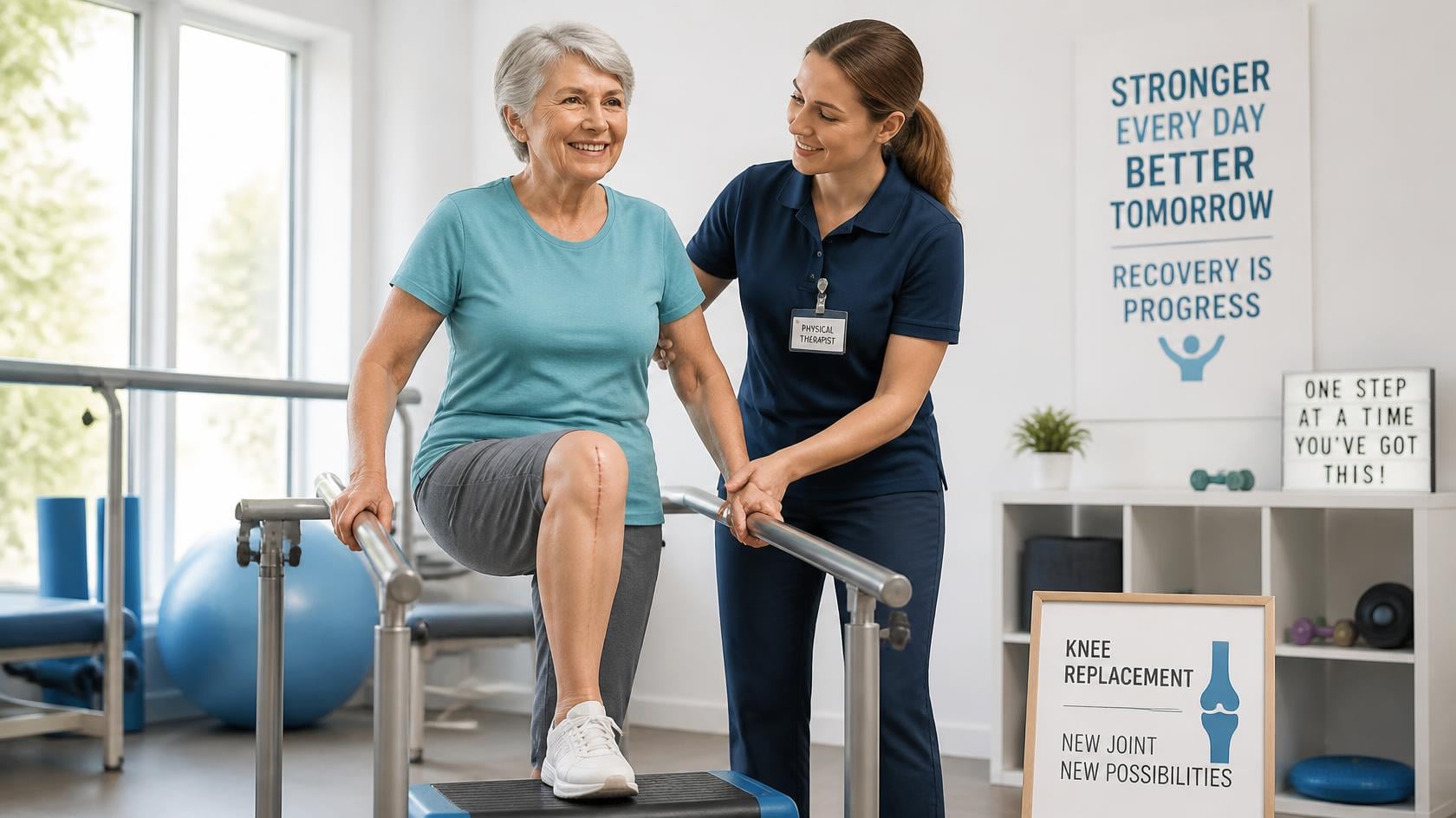
If there is a single factor that separates a smooth recovery from a frustrating one, it is physiotherapy. Therapy usually begins within a day of surgery and continues for several weeks, combining supervised sessions with a home exercise programme. Early on, the priority is range of motion — getting the knee to both bend and fully straighten — because that window doesn't stay open forever. Strengthening the quadriceps, hamstrings and hip muscles comes next and is what ultimately smooths out your walking.
Walking is wonderful for general recovery, but on its own it won't rebuild the specific strength your new knee needs. The targeted exercises your physiotherapist gives you are what do that job.
Driving, work and activity
| Milestone | Typical timing | What it depends on |
|---|---|---|
| Walking unaided | 4–6 weeks | Strength, balance, confidence |
| Driving | 4–6 weeks | Off strong pain meds; left knee & automatic may be sooner; surgeon clearance |
| Desk / office work | 4–6 weeks | How much sitting vs. moving is involved |
| Physically demanding work | 2–3 months+ | Lifting, standing and walking demands |
| Low-impact exercise | From 6–12 weeks | Walking, cycling, swimming — cleared by your team |
| Higher-impact hobbies | 8–12 weeks+ | Golf, hiking, doubles tennis — gradually |
Before driving again, you need to be off medication that affects your reactions, able to bend the knee enough to work the pedals, and confident you could brake hard in an emergency. Practising in a quiet car park first is a sensible step.
Do's and don'ts
Do
- Do your prescribed exercises every day, even when progress feels small.
- Do ice and elevate to control swelling.
- Do get up and move regularly to keep circulation going.
- Do keep the wound clean and dry, and shower with a waterproof dressing if advised.
- Do set small weekly goals and celebrate them.
Don't
- Don't twist or pivot sharply on the operated leg.
- Don't put a pillow behind the knee — it stiffens bent.
- Don't soak the wound in baths, pools or the sea until cleared.
- Don't drive while taking strong pain medication.
- Don't push into high-impact activity just because you feel good early.
Warning signs to act on
Serious complications are uncommon, but knowing the red flags means you can act quickly. Contact your surgeon promptly, or seek emergency care, if you notice:
- Signs of infection: fever, spreading redness or warmth around the wound, or fluid leaking from it.
- Possible blood clot in the leg: new calf pain, tenderness or swelling, usually in one leg.
- A medical emergency: chest pain or sudden shortness of breath — call 995 immediately.
- Sudden, severe pain that is very different from your usual recovery discomfort.
What recovery looks like here
Practice in Singapore has moved strongly towards enhanced recovery. Many suitable patients now follow an accelerated pathway, sometimes going home as early as the first day after surgery rather than staying in hospital for several days. Local research has found that extra inpatient time in a community hospital for physiotherapy doesn't necessarily lead to better long-term function than recovering at home with a good outpatient or home-based programme — for the right patient, home is often the better place to heal.
Good family support at home, a safe environment free of trip hazards, and reliable access to physiotherapy matter more than where the rehabilitation happens. Your care team will help you plan this before you're even admitted, and can advise on how MediSave, MediShield Life and any Integrated Shield Plan apply to your procedure and follow-up.
Frequently asked questions
What is the hardest part of knee replacement recovery?
For most people it's the first one to two weeks at home, when pain, swelling and stiffness are at their peak and sleep can be disrupted. The first two to six weeks overall are the most demanding stretch. It gets steadily easier from there — and knowing that in advance makes the early days easier to weather.
How long does the pain last?
The sharpest pain eases over the first two to three weeks, and stronger medication is usually only needed in that early window. Milder aches and swelling can come and go for a few months, especially after a busy day, which is normal as the tissues heal.
When can I walk normally again?
Most patients walk with a frame or crutches from day one, move to a cane around weeks two to four, and walk unaided by roughly four to six weeks. A lingering limp is common for a while and usually comes from stiffness or quadriceps weakness — both of which physiotherapy addresses.
When can I drive after knee replacement?
Often around four to six weeks, sometimes sooner if it was your left knee and you drive an automatic. You must be off strong pain medication and cleared by your surgeon first, because your reaction time and ability to brake safely have to be back to normal.
What's the fastest way to recover?
There's no shortcut, but the biggest levers are within your control: do your physiotherapy exercises consistently, keep swelling down with ice and elevation, take pain relief so you can move, and progress steadily rather than pushing into high-impact activity too soon. Preparing your body and home before surgery ("prehab") helps too.
Is walking enough, or do I still need exercises?
Walking is excellent for circulation and general fitness, but it doesn't rebuild the specific strength and range of motion your new knee needs. The targeted exercises from your physiotherapist are what restore those — walking complements them rather than replacing them.
How long will the implant last?
Most knee replacements function well for at least 10 to 15 years, and modern implants commonly last 15 to 20 years or more. For many people, the new knee lasts the rest of their life.
Planning a knee replacement, or recovering from one?
Our orthopaedic team will map out a recovery plan built around your health, your home and your goals — and stay with you through every phase. If you're still weighing the decision, start with our overview of knee replacement surgery in Singapore.
Book a consultation