
Knee Specialist
in Singapore
Persistent knee pain or a knee injury deserves an accurate diagnosis — not guesswork. Our two fellowship-trained orthopaedic surgeons subspecialise exclusively in hip and knee care, from injections to robotic knee replacement.
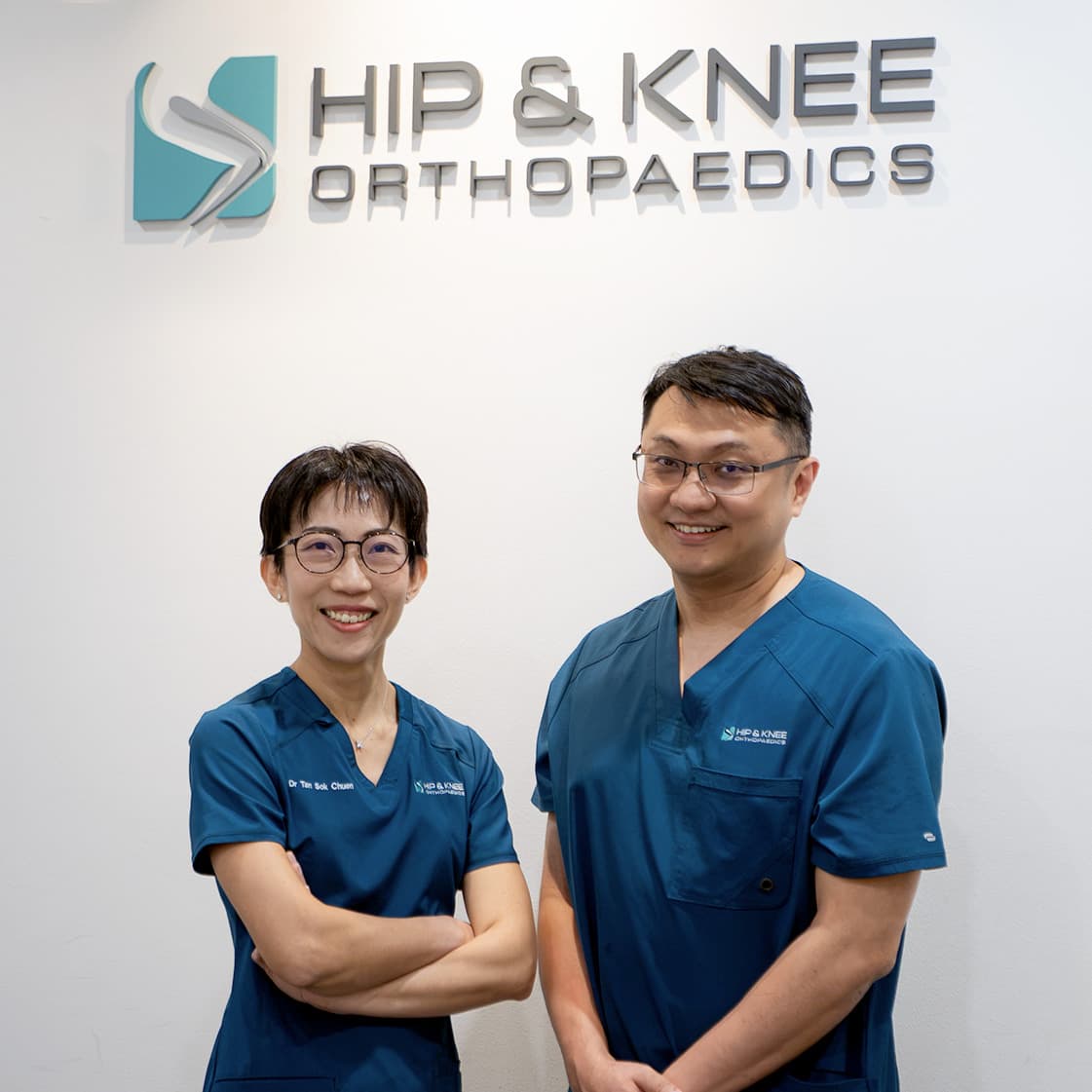
What is a knee specialist?
A knee specialist is an orthopaedic surgeon — a medical doctor with specialist training in the musculoskeletal system — who focuses on diagnosing and treating knee conditions. In Singapore, that means a doctor registered with the Singapore Medical Council, typically holding a Master of Medicine in Orthopaedic Surgery (MMed Ortho) and a Fellowship of the Royal College of Surgeons of Edinburgh (FRCSEd), usually followed by further subspecialty training — a fellowship — in hip and knee surgery.
People use several terms for the same doctor: "knee doctor", "knee surgeon", "knee pain specialist". When you see a knee doctor in Singapore, you should be seeing a trained orthopaedic surgeon who can manage your condition from the first consultation through to surgery and recovery — not a practitioner who can only refer you on. A good knee specialist won't rush to surgery either: the most useful first visit is one that pins down the exact cause of your pain and then explains the full range of options, surgical and non-surgical, in language you can act on.
Both our knee specialists hold dual international fellowships — at the Nuffield Orthopaedic Centre, Oxford (world-renowned for partial knee replacement) and the London Health Sciences Centre, Canada (a leading joint-revision centre) — and each brings over 20 years of clinical experience.
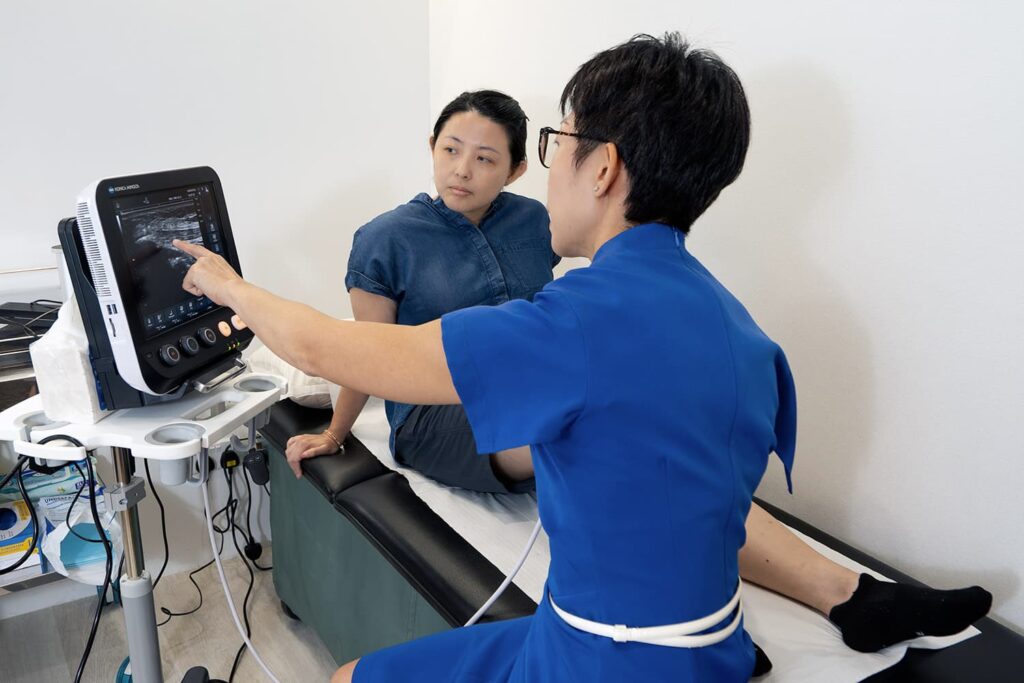
When should you see a knee specialist?
Not every knee ache needs a specialist. But if any of the following apply, see a knee doctor for a proper evaluation rather than waiting it out:
- Pain that doesn't improve after 2–4 weeks of rest and simple pain relief
- Swelling that persists or keeps returning after activity
- A locking or catching knee that gets stuck, then releases
- Giving way or instability — the knee "gives out" under you
- Pain that wakes you at night or stops normal daily activities
- Difficulty bearing weight, or a knee that looks deformed
- Pain after a twisting injury, fall or sports impact
- Symptoms getting worse despite physiotherapy
A knee pain specialist can tell you whether your problem is muscular, ligamentous, meniscal or arthritic — and the different causes of knee pain each call for completely different treatment. Getting the right diagnosis early often means simpler, less invasive care. Use our knee pain location chart to narrow it down before your visit.
Common knee conditions we treat
As a dedicated knee clinic in Singapore, we see the full range of knee problems — from sports injuries in active adults to advanced arthritis in older patients. Because the treatment for each is completely different, an accurate diagnosis from a knee pain specialist is the single most important step in getting better.
Knee osteoarthritis
The most common cause of knee pain over 50 — worn cartilage leading to bone-on-bone friction.
Exercises for knee OA →Meniscus tears
Torn shock-absorbing cartilage from twisting injuries or gradual degeneration.
Meniscus repair →ACL & ligament injuries
Sports injuries that often come with a sense of instability or giving way.
ACL tear & reconstruction →Cartilage damage
Focal cartilage defects that can progress to arthritis if left untreated.
Cartilage repair →Patella instability
Kneecap instability and anterior knee pain, common in younger, active patients.
Patella instability →Overuse & post-injury pain
Bursitis, tendonitis and post-traumatic knee pain in runners, cyclists and athletes.
Knee evaluation →Your knee consultation, step by step
A first visit with a knee specialist in Singapore typically takes 30–45 minutes. We believe in shared decision-making — you'll understand why a treatment is recommended, and what the alternatives are, before anything is done.
History
How the pain started, what makes it better or worse, your activity level and your goals.
Physical examination
Range of motion, stability and swelling, plus specific tests for ligament and meniscus injuries — often with in-clinic ultrasound.
Imaging, if needed
X-rays for alignment and arthritis; MRI for ligaments, meniscus and cartilage. Same-day X-ray in the same building.
Diagnosis & plan
A clear diagnosis in plain language, with non-surgical options explored first. More on our knee evaluation →
Knee treatment options
Many knee conditions — including mild to moderate arthritis — can be managed successfully without surgery. When surgery is needed, we use minimally invasive (arthroscopic) techniques wherever possible.
Non-surgical
- Physiotherapy & targeted exercise — the foundation of knee care; strengthening the surrounding muscles offloads the joint
- Activity modification & bracing
- Weight management — every kilogram lost reduces load on the knee. Learn more →
- Injections — steroid injections for flare-ups, viscosupplementation (gel), and Cingal, a combined steroid + hyaluronic acid injection giving up to 6 months of relief
- Pain medication — short-term, under medical supervision
Surgical
- Arthroscopic (keyhole) surgery to diagnose and treat problems inside the joint
- Meniscus repair — preserving the shock-absorbing cartilage where possible
- ACL reconstruction — rebuilding a torn ligament, often with a hamstring graft
- Cartilage repair / restoration for focal defects
- Partial knee replacement (PKR) — replacing only the damaged compartment; Dr Lau trained in this at Oxford's Nuffield Orthopaedic Centre. Partial vs total →
- Robotic-assisted knee replacement using MAKO (Stryker), VELYS (J&J) and ROSA (Zimmer Biomet) for precise alignment — see how the leading robotic systems compare. Knee replacement →
- Complex & revision knee replacement for failed previous replacements
A knee-only practice, built around you
Fellowship-trained, subspecialty surgeons
Both doctors completed international fellowships in hip and knee surgery at Oxford and in Canada; Dr Lau served as Director of Hip and Knee Surgery at Changi General Hospital.
Knee care only
We don't dilute our practice — hip and knee is all we do, which means depth of experience in exactly the problem you have.
Unhurried, plain-language consultations
30–45 minutes, bilingual (English and Mandarin), with the reasoning behind every recommendation explained clearly.
MediSave & Integrated Shield Plans
MediSave-accredited and on the panel of most Integrated Shield Plans, with claims assistance for eligible procedures. Insurance & MediSave →
Full non-surgical to surgical pathway
Injections, physiotherapy, keyhole surgery and robotic replacement — all under one roof, so you're never passed between providers.
Prime Novena location
Mount Elizabeth Novena Specialist Centre — 3 minutes from Novena MRT.
Recovery, rehabilitation and protecting your knees
Treatment is only half the journey. Whether you've had an injection, keyhole surgery or a knee replacement, structured rehabilitation is what restores strength, movement and confidence in the joint. Our physiotherapy partners guide you through a graded programme — early mobilisation first, then progressive strengthening of the muscles that support and offload the knee.
Most patients recovering from knee replacement stand and walk with aids within 24 hours, resume light daily activities over the first few weeks, and continue improving in strength and flexibility for 6–12 months. Your surgeon and therapist adjust the plan to your pace, your job and your goals.
Many knee problems can also be slowed or prevented. A few habits make a real difference:
- Keep moving with low-impact exercise — swimming, cycling or walking builds the muscles that stabilise the knee
- Manage your weight — every kilogram lost reduces load through the joint
- Warm up and progress training gradually to avoid overuse injuries
- Wear supportive footwear and address alignment issues early
- See a knee doctor early when symptoms persist — small problems are easier to treat than advanced ones
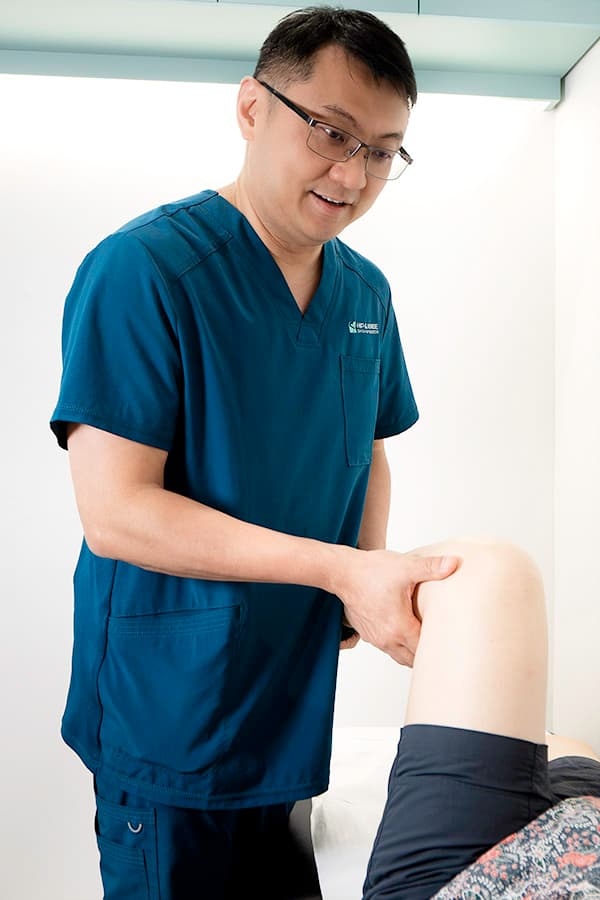
Two surgeons, one subspecialty
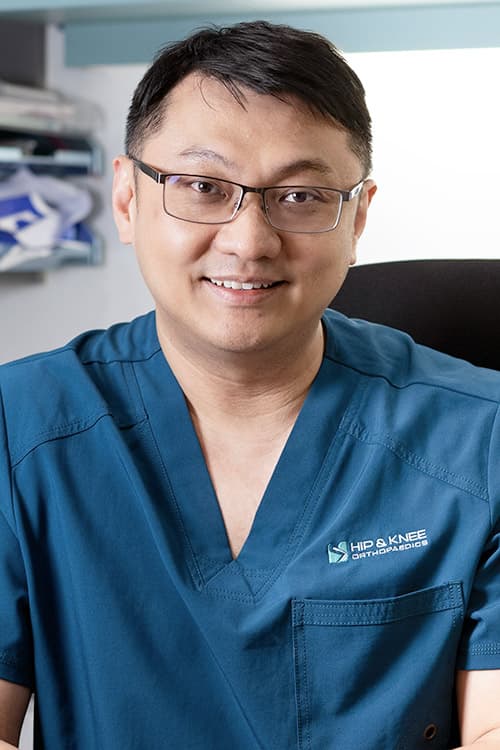
Dr Adrian Lau
Subspecialising in primary and complex hip and knee replacement. Awarded the Ministry of Health Training Award (2014); completed a fellowship in revision hip and knee surgery at the London Health Sciences Centre, Canada (2015) and a second fellowship at the Nuffield Orthopaedic Centre, Oxford, in unicompartmental (partial) knee replacement. Also performs arthroscopic knee surgery — meniscus repairs, ligament reconstructions and cartilage repair. Formerly Consultant and Director of Hip and Knee Surgery at Changi General Hospital.
Full profile
Dr Tan Sok Chuen
Subspecialty training in hip and knee surgery, with clinical fellowships at the Nuffield Orthopaedic Centre, Oxford (2016) — renowned for partial knee replacement — and the London Health Sciences Centre, Canada (2015). Special interests in minimally invasive joint replacement, sports injuries, ligament reconstruction and cartilage repair. Member of the Sports Medicine Association Singapore.
Full profileWe strongly believe that non-surgical treatments should always be the first option, with surgery explored only if needed. — The team at Hip & Knee Orthopaedics
Frequently asked questions
Who is the best knee specialist in Singapore?
Look for an orthopaedic surgeon registered with the Singapore Medical Council who subspecialises in knee surgery — check for specialist accreditation (MMed Ortho / FRCSEd), additional international fellowship training and hospital privileges. At Hip & Knee Orthopaedics, both Dr Adrian Lau and Dr Tan Sok Chuen hold dual international fellowships in hip and knee surgery from Oxford and the London Health Sciences Centre, Canada, and practise at Mount Elizabeth Novena Specialist Centre.
What does a knee specialist do?
A knee specialist diagnoses and treats conditions of the knee — from arthritis, meniscus tears and ligament injuries to sports injuries and knee replacement. They can manage your care non-surgically (physiotherapy, injections) or surgically (keyhole surgery, partial or total knee replacement), so you don't get passed between providers.
When should I see a knee doctor for knee pain?
See a knee doctor if pain persists beyond 2–4 weeks despite rest, if the knee swells, locks or gives way, if it prevents normal daily activities, or if you have pain after an injury. Early evaluation usually means simpler treatment.
How much does it cost to see a knee specialist in Singapore?
Our initial consultation starts from $218 (including 9% GST). Surgery costs vary by procedure, implant and insurance coverage — we provide itemised quotes and assist with MediSave and Integrated Shield Plan claims.
Do I need a referral to see a knee specialist in Singapore?
No referral is needed for a private consultation at our clinic. You can book directly by calling 8884 1642 or via our contact page. If you're using a corporate or panel plan, check your plan's requirements first.
Is knee surgery the only option for knee pain?
No. Many knee conditions — including mild to moderate arthritis — are managed successfully with physiotherapy, activity modification, weight management and injections such as Cingal. Surgery is recommended only when non-surgical options have been exhausted, or when there's structural damage that won't heal on its own.
How do I choose a knee surgeon in Singapore?
Choose a surgeon who subspecialises in knees (not general orthopaedics), with verifiable training — look for fellowship experience at recognised international centres — and who communicates clearly about your options. Ask how many of your procedure they perform each year and what their approach to recovery is.
Do you accept MediSave for knee surgery?
Yes. MediSave can be used for eligible knee procedures, and we assist with MediSave claims and most Integrated Shield Plans. Speak to our team to confirm eligibility for your specific procedure.
How long is recovery after knee replacement surgery?
Most patients stand and walk with aids within 24 hours, drive after 2–4 weeks, and return to work within 4–8 weeks depending on their job. Full recovery continues over 6–12 months. Read our recovery guide →
Where is your knee clinic located?
Mount Elizabeth Novena Specialist Centre, 38 Irrawaddy Road, #09-21 / #09-38, Singapore 329563 — 3 minutes from Novena MRT. Contact us →
Related knee services & reading
Knee services
From our blog
- Why & when to consider a knee replacement
- Total vs partial knee replacement
- Robotic knee replacement, compared
- Recovery after knee replacement surgery
- Enhanced Recovery After Surgery (ERAS)
- Knee pain causes & treatments
- Best & worst exercises for knee osteoarthritis
- Can weight loss reduce knee pain?
- Knee pain location chart
Consult our knee specialists
Persistent knee pain or reduced mobility is worth an accurate diagnosis. Book a same-week appointment with a fellowship-trained knee doctor in Singapore.
38 Irrawaddy Road, #09-21 / #09-38, S329563
Closed Sun & public holidays