Robotic Knee Replacement in Singapore
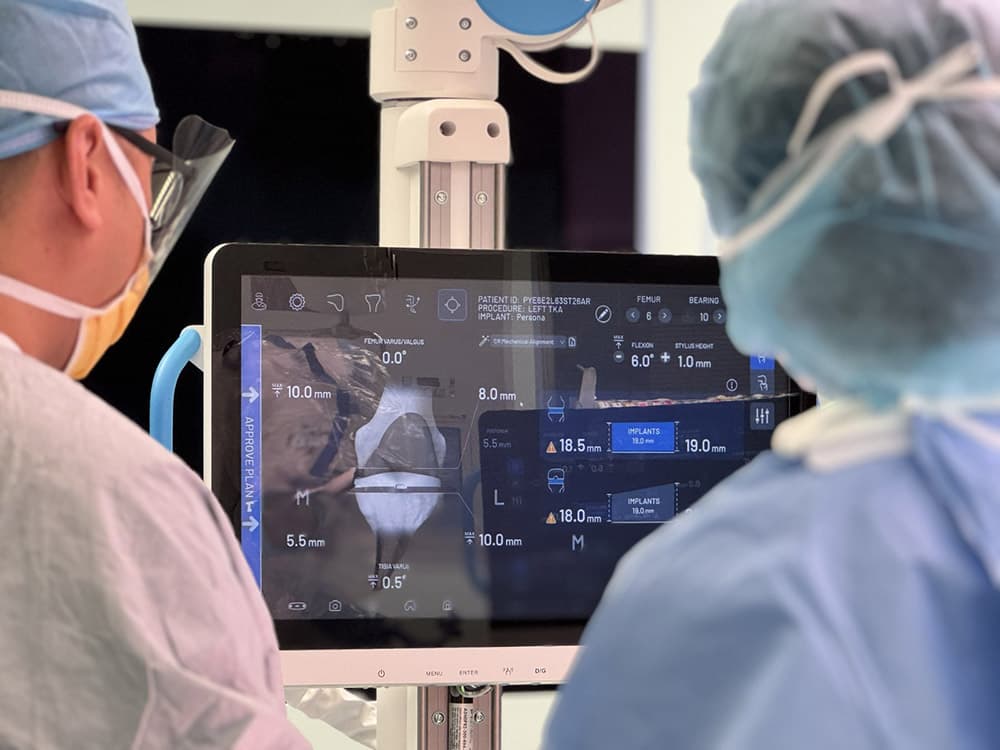
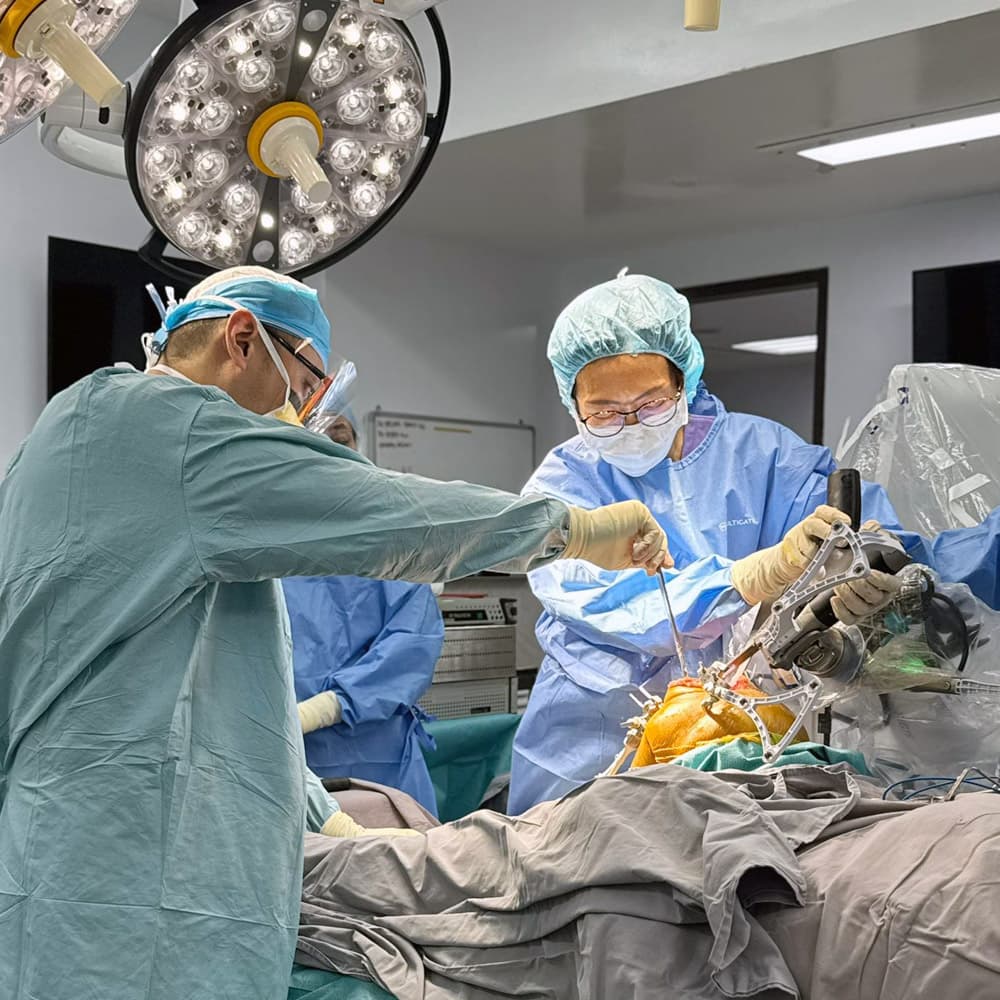
Robotic-assisted knee replacement combines pre-operative 3D planning with a robotic arm that helps guide bone cuts with sub-millimetre precision – performed entirely by your surgeon, with the robot acting as a highly accurate measuring and cutting guide, not an autonomous system.
At Hip & Knee Orthopaedics, we offer robotic-assisted knee replacement where it genuinely benefits the patient, and will tell you directly when a conventional or navigated approach is just as appropriate for your knee. We think that honesty is part of the service.
What Robotic Assistance Changes During Your Surgery
Two things differ from a conventional knee replacement:
- Planning happens before you’re on the operating table. A CT scan (or intra-operative imageless mapping, depending on the system) builds a 3D model of your knee, letting Dr Lau plan implant size, position, and limb alignment digitally before making a single cut.
- Bone cuts are executed within a guided boundary. A robotic arm provides real-time feedback so cuts stay within the planned zone — while Dr Lau remains fully in control throughout, adjusting for soft-tissue balance and your individual anatomy as the surgery progresses.
Is Robotic Knee Replacement Right for You?
Robotic assistance isn’t automatically the best choice for every patient — and we’d rather tell you that upfront than let you assume “robotic” always means “better.”
It’s most likely to benefit your case if:
- You need a partial (unicompartmental) knee replacement – the evidence for a precision benefit is clearest here, since preserving the healthy parts of the knee has a smaller margin for error.
- You have significant deformity or altered anatomy – from a prior fracture, previous surgery, or unusual alignment — where a detailed pre-operative plan gives our doctors meaningfully more information than X-rays alone.
- You’re having a revision (repeat) knee replacement, where anatomy is altered and precise planning matters more.
It’s less likely to be the deciding factor if:
- You have a straightforward primary total knee replacement with typical anatomy, where an experienced surgeon using conventional or navigated technique can achieve a comparably good result.
- Cost is a major consideration — robotic-assisted surgery carries a premium that isn’t consistently reflected in better long-term patient outcomes in current published evidence.
Our doctors will discuss which category best fits your knee at your consultation, based on your imaging and history – not a standard recommendation applied to every patient.
What the Evidence Actually Supports
We’d rather set accurate expectations than oversell the technology.
Well-supported by current evidence:
- More accurate implant positioning and limb alignment compared with conventional jig-based technique.
- Less soft-tissue and bone trauma during surgery, with slightly faster early functional recovery in the first days to weeks.
- A clearer, longer-established precision benefit specifically for partial knee replacement.
Still being studied:
- Whether more accurate alignment reliably means a longer-lasting implant — most robotic systems have only been in wide use since the mid-2010s, so long-term (15–20 year) revision-rate data doesn’t yet exist the way it does for conventional knee replacement.
- Whether patients report feeling meaningfully better long-term — most published studies to date show similar patient-reported outcomes at 2–10 years between robotic-assisted and conventional replacement performed by an experienced surgeon.
- Robotic assistance doesn’t meaningfully change infection risk, blood clot risk, or your overall rehabilitation pace — these depend far more on your general health and physiotherapy adherence than on surgical technique.
The Robotic System We Use
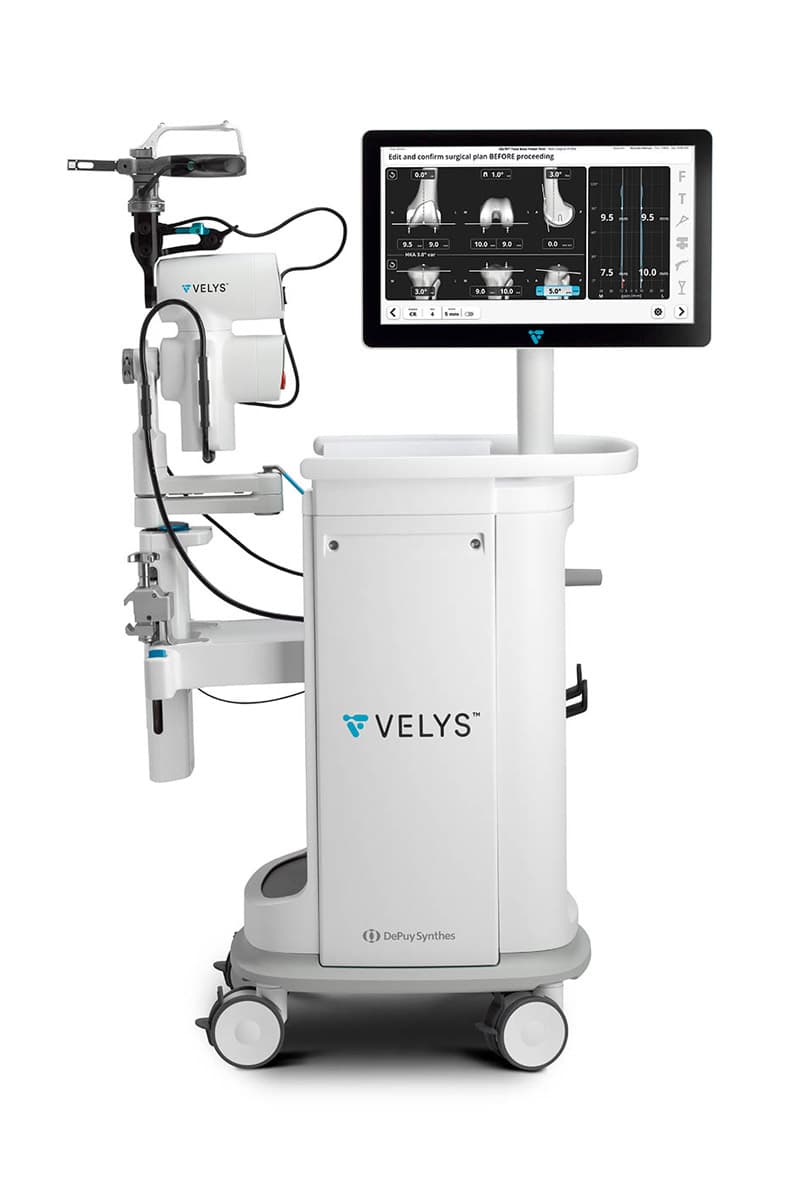
Hip & Knee Orthopaedics uses VELYS™ Robotic-Assisted Solution, which uses ADAPTIVE TRACKING™ and NATURAL CONTROL™ technology to enable accurate and precise implant placement. This translates to faster recovery, less pain and shorter hospital stays. Reference: https://pubmed.ncbi.nlm.nih.gov/41931170/
The clinic also uses Zimmer Rosa and Stryker Mako.
Robotic vs. Navigated vs. Conventional: Your Options at a Glance
| Approach | How alignment is planned | How cuts are made |
|---|---|---|
| Conventional (jig-based) | Anatomical landmarks and mechanical jigs, guided by X-rays and surgeon experience | Manual saw, guided by the jig |
| Computer-navigated | Real-time infrared tracking during surgery, displayed on screen | Manual saw, guided by on-screen data — no robotic arm |
| Robotic-assisted | Pre-operative CT-based 3D plan, or imageless intra-operative mapping | Robotic arm constrains the cutting boundary within the plan |
Why Choose Hip & Knee Orthopaedics
- A surgeon who tells you when robotic isn’t necessary. Our knee specialists will recommend conventional or navigated technique when the evidence doesn’t support paying a premium for your specific case.
- Fellowship-trained expertise across conventional, navigated, and robotic-assisted knee replacement, so the technique is chosen for your knee — not the other way around.
- A clear, itemised cost estimate before you commit, including what MediSave and insurance can realistically offset.
Recovery: What to Realistically Expect
Robotic assistance can mean slightly less swelling and pain in the first 1-2 weeks, and marginally earlier basic milestones like straight-leg raise and unassisted walking.
It does not significantly shorten the overall 3–6 month path back to full activity – that depends far more on your physiotherapy adherence, age, and pre-surgery fitness than on how the bone cuts were made. Our doctors will walk you through a realistic, personalised recovery timeline at your consultation.
Screening for New Patients
$235 exclusive of GST
Evaluation of Knee Pain with X-ray
Estimated Cost of Robotic Knee Replacement in Singapore
Robotic-assisted knee replacement typically costs more than conventional surgery, reflecting equipment and per-case costs rather than a longer procedure.
In private hospitals, robotic knee replacement surgery may cost approximately $42,600 to $50,000 before insurance or MediSave deductions, depending on factors such as implant type, surgical complexity, and technology used. Surgeon fee for this procedure is at $10600 (mid-MOH Benchmark), not inclusive of GST.
For a personalised cost estimate and financial counselling, please contact our clinic so we can guide you through the expected fees, insurance coverage, and payment options.
It's genuinely unclear yet. Robotic assistance improves implant alignment accuracy, a known factor in early implant loosening, but most systems haven't been in wide use long enough to generate the 15–20 year revision-rate data available for conventional knee replacement.
Yes - MediSave limits are set by the procedure's classification under MOH's Table of Surgical Procedures, not by whether robotic technology was used. Since robotic surgery typically has a higher total bill, MediSave and insurance will usually cover a smaller percentage of the total.
Yes. This is a reasonable discussion to have with our doctors, particularly for a straightforward primary knee replacement where the evidence for a meaningful outcome difference is weaker.
Yes - and the evidence base is strongest for partial (unicompartmental) knee replacement, where robotic guidance has the longest track record of measurable benefit.

Dr Adrian Lau
Knee Specialist in Singapore
Dr Adrian Lau is a specialist orthopaedic surgeon trained in primary and complex hip and knee arthroplasty.

Dr Tan Sok Chuen
Knee Specialist in Singapore
Dr Tan is an orthopaedic doctor with subspecialty training in hip and knee surgery – making her the first female hip and knee replacement surgeon in Singapore.
Read from Our Blog
Our doctors share their journeys as orthopaedic surgeons as well as offer insights and tips.