Knee replacement surgery has come a long way from the days of manual instrumentation and jigs alone. Today, robotic knee replacement is reshaping how surgeons plan and execute total and partial knee arthroplasty, giving patients a more personalized path to recovery. If you’re researching options for knee replacement, understanding how robotic-assisted technology works — and how the major systems differ — can help you have a more informed conversation with your surgeon.
What is Robotic Knee Replacement?
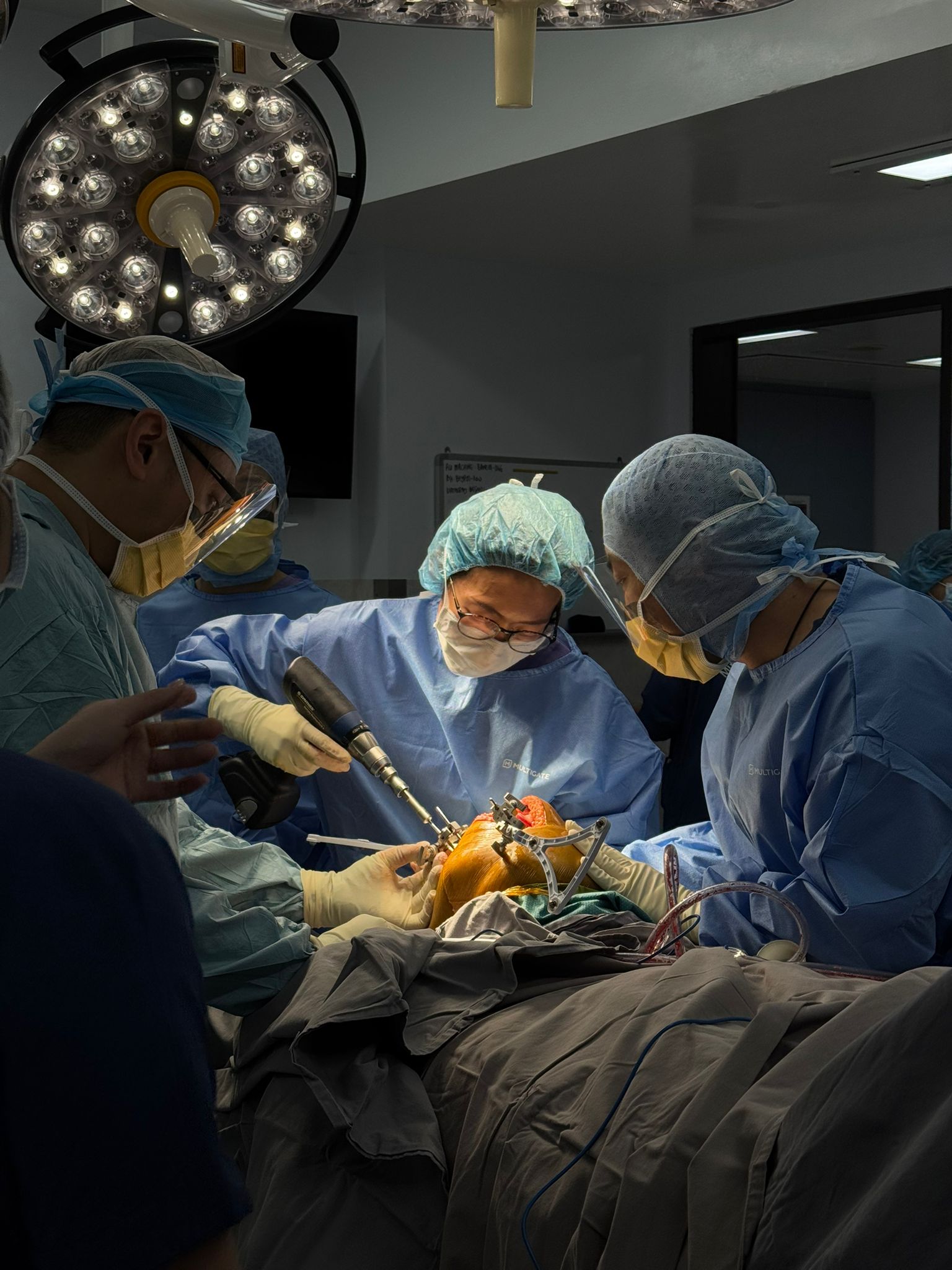
Robotic knee replacement (also called robotic-assisted or robotic-arm-assisted total knee arthroplasty) combines advanced imaging, computer planning, and robotic guidance to help surgeons prepare bone surfaces and position implants with a high degree of precision. It’s important to understand what this technology is not: the robot does not perform the surgery independently. The surgeon remains in full control throughout the procedure. The robotic system acts as a highly precise assistant, translating a personalized surgical plan into more accurate, reproducible bone cuts.
The process typically involves three stages:
1. Preoperative planning — imaging (X-ray or CT scan, depending on the system) is used to build a 3D model of the patient’s knee anatomy.
2. Surgical planning — the surgeon uses that model to plan implant size, position, and alignment specific to the patient’s anatomy and soft-tissue balance.
3. Intraoperative execution — the robotic system guides or constrains the surgeon’s instruments to execute the plan accurately, often adjusting in real time based on live data collected during surgery.
Advantages of Robotic Knee Replacement
Robotic-assisted technology has been adopted rapidly across orthopedic practices, and for good reason. Reported advantages of robotic knee replacement include:
– Greater precision in implant alignment. Robotic guidance reduces variability in bone cuts compared with manual instrumentation, which can support more accurate implant positioning.
– Personalized surgical planning. Each plan is built around the patient’s own anatomy rather than a one-size-fits-all approach, supporting alignment philosophies such as personalized or functional alignment.
– Better protection of soft tissue. Because the robotic system constrains cuts to the planned area, there’s typically less disruption to the surrounding ligaments and soft tissue than with conventional jig-based techniques.
– Potential for faster recovery. Some studies point to shorter hospital stays, improved early mobility, and less post-operative pain with robotic-assisted procedures compared with manual techniques.
– Data-driven decision-making. Real-time intraoperative data — such as soft-tissue tension and gap balancing — gives surgeons objective information to fine-tune the plan during surgery, rather than relying on feel alone.
– High patient satisfaction. Several robotic knee systems report strong patient satisfaction scores in both short- and long-term follow-up studies.
It’s worth noting that outcomes depend heavily on surgeon experience and patient-specific factors, and robotic assistance is a tool that supports — rather than replaces — surgical skill.
The Leading Robotic Knee Replacement Systems
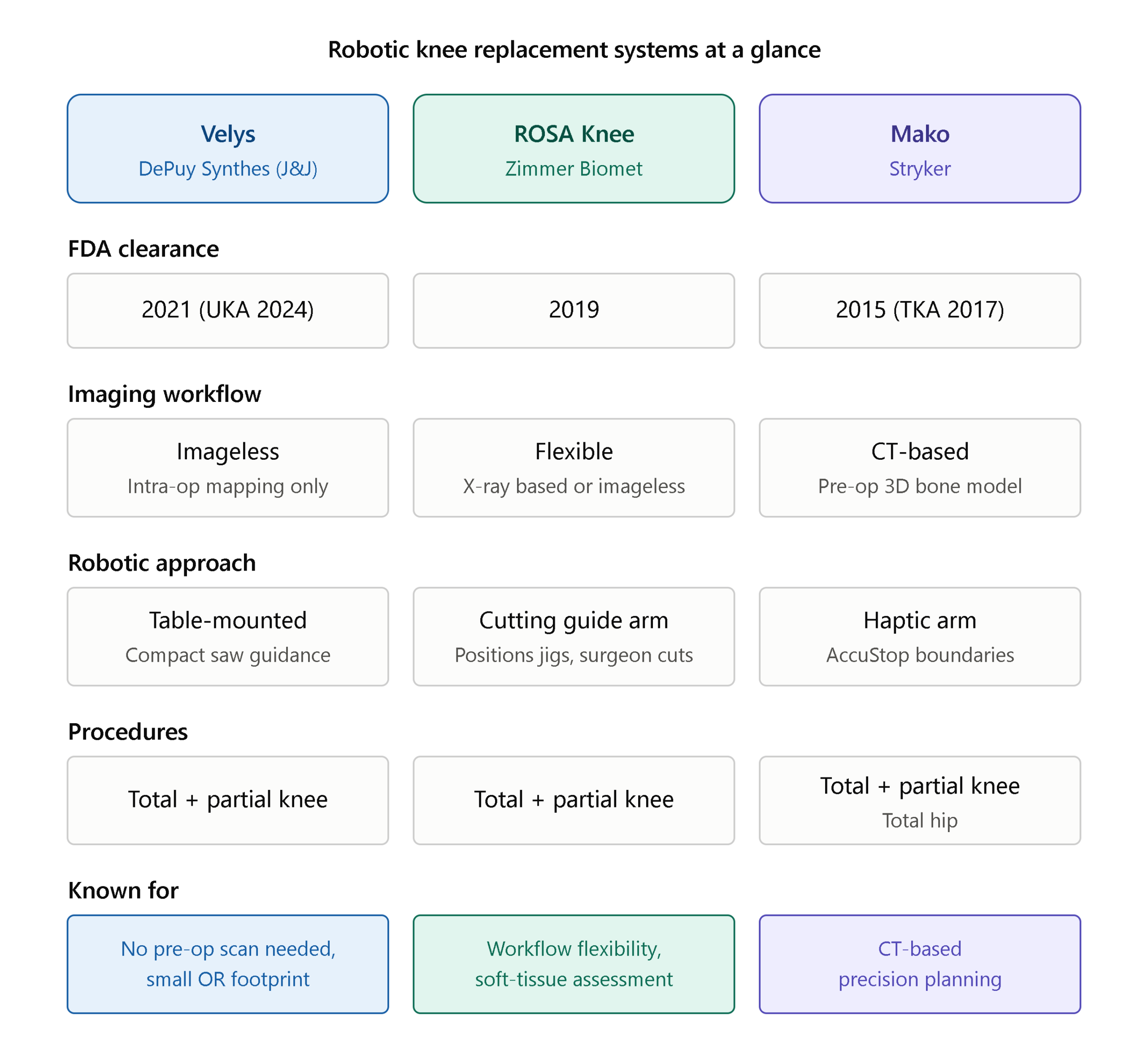
Three systems currently dominate the robotic knee replacement space in the U.S. and internationally: VELYS(J&J), ROSA(Zimmer), and Makoplasty(Stryker). While all three aim to improve accuracy and personalization, they take meaningfully different approaches to imaging, planning, and execution.
VELYS Robotic-Assisted Solution (DePuy Synthes)
The VELYS Robotic-Assisted Solution, developed by DePuy Synthes (part of Johnson & Johnson MedTech), is one of the newer entrants in the robotic knee space. It’s an imageless system, meaning it doesn’t require a preoperative CT scan — instead, it builds its surgical plan using data gathered directly during surgery through optical tracking. This makes VELYS a more compact, streamlined system designed to fit efficiently into existing operating room workflows without the added step (and cost) of preoperative imaging.
VELYS works exclusively with the ATTUNE Knee System, an implant platform used in more than a million procedures worldwide and designed to support a natural range of motion. Early clinical data on VELYS has shown accurate coronal alignment, reduced hospitalization time, and high patient satisfaction and expectation-fulfillment scores compared with conventional manual technique.
ROSA Knee System (Zimmer Biomet)
The ROSA Knee System takes a different approach with its proprietary X-Atlas imaging technology, which converts standard 2D X-rays into a 3D bone model for preoperative planning — avoiding the radiation exposure of a full CT scan while still offering image-based planning if a surgeon prefers it (ROSA can also be used in an imageless mode). During surgery, ROSA provides real-time data on soft-tissue tension and gap balancing across flexion and extension, helping surgeons fine-tune ligament balance.
ROSA is compatible with several proven Zimmer Biomet implant platforms, most notably the Persona Knee System, and supports multiple surgical techniques including personalized alignment, gap balancing, measured resection, and hybrid approaches. It’s also part of Zimmer Biomet’s broader ZBEdge ecosystem, which connects surgical data with post-operative recovery tracking.
Mako SmartRobotics (Stryker)
Mako, developed by Stryker, is the most established of the three systems and has been used in more than a million joint procedures. It relies on CT-based 3D planning: patients undergo a preoperative CT scan, which Mako uses to build a highly detailed, patient-specific model. Surgeons can then virtually plan and even rehearse the procedure before entering the operating room.
A defining feature of Mako is its AccuStop haptic technology, which creates a physical boundary that helps guide the surgeon’s instruments within the planned cutting area — providing tactile feedback that helps protect surrounding bone and soft tissue. Mako Total Knee pairs with Stryker’s Triathlon Knee System implant, and the platform also includes insightful data analytics that let surgeons track and refine their outcomes over time.
Is Robotic Knee Replacement right for you?
Robotic-assisted technology has expanded access to more precise, personalized knee replacement, but it isn’t the only factor that determines a good outcome. Surgeon experience, overall health, activity goals, and the severity of joint damage all play an important role. If you’re considering knee replacement, ask your surgeon which robotic system they use, why they chose it, and how it might benefit your specific case.
Why choose Hip & Knee Orthopaedics for Robotic Knee Replacement?
Choosing where to have robotic knee replacement is just as important as choosing the technology itself, and this is where Hip & Knee Orthopaedics stands apart. Dr Tan Sok Chuen and Dr Adrian Lau are both double fellowship-trained orthopaedic surgeons, having each completed two-year subspecialty fellowships at renowned centres before spending years operating in high-volume public hospitals — experience that now informs their private practice. Rather than being limited to a single robotic platform, the clinic offers robotic-assisted knee replacement using VELYS, ROSA, and Mako, the same three leading systems compared in this article. This means your surgeon can select the technology best suited to your individual anatomy and surgical plan, rather than fitting your knee to whichever system happens to be on hand. Combined with a genuinely patient-first philosophy — non-surgical treatment is always explored first, and surgery is only recommended when it’s truly the right option. The clinic is also Medisave-accredited and on the panel of most Integrated Shield Plans, helping make robotic knee replacement in Singapore more accessible and affordable.