Published · Last updated
Knee Pain Location Chart: Identify Pain Areas, Causes & Symptoms
Where your knee hurts is one of the most useful clues to what's wrong with it. Use this location-by-location guide to understand what pain at the front, kneecap, inner side, outer side, back or above the knee may mean — and when to have it checked.
Reviewed & approved by Dr Adrian Lau, Orthopaedic Surgeon — MBBS, MRCSEd, MMed (Orth), FRCSEd (Tr & Orth).
Published 20 March 2023 · Last updated 14 August 2026

Why the location of knee pain matters
The knee is the largest and most complex joint in the body. Because so many structures — bone, cartilage, ligaments, tendons and fluid-filled bursae — sit within a few centimetres of each other, a problem in one area can feel very different from a problem just an inch away.
That is exactly why "where does it hurt?" is usually the first question a specialist asks. The location of your pain, combined with the type of pain (sharp, dull or aching) and the activities that trigger it, helps narrow down the cause quickly. Knowing how to describe it makes a knee evaluation faster and more precise.
This chart is a starting point for understanding your symptoms — not a diagnosis. Many knee conditions share overlapping symptoms, and pain can shift or refer from elsewhere, so a hands-on assessment is still needed to confirm the cause.

Understanding knee anatomy
The knee is a hinge joint connecting the thigh bone (femur) to the shin bone (tibia), with the kneecap (patella) resting in front. A few key structures do most of the work:
Cartilage — the meniscus and articular cartilage cushion the bones and absorb shock.
Ligaments — the ACL, PCL, MCL and LCL stabilise the joint.
Tendons — attach the quadriceps and hamstring muscles to bone, enabling movement.
Bursae — small fluid-filled sacs that reduce friction as the joint moves.
Knowing which structure sits in each region is what lets a specialist read pain location as a diagnostic signal rather than just a description of discomfort.

Pain at the front of the knee
Pain across the front of the knee — often called anterior knee pain — is one of the most common presentations. It is typically felt as a dull ache that worsens when climbing stairs, squatting, or sitting for long periods.
Patellofemoral pain syndrome
A catch-all term for pain arising from how the kneecap moves in its groove on the thigh bone. Weak quadriceps, muscle imbalance, overuse or alignment issues can all contribute.
Symptoms: aching front-of-knee pain, worse on stairs or after prolonged sitting ("theatre sign"). Learn more about knee pain when climbing stairs.Chondromalacia patellae
Softening or damage of the cartilage on the underside of the kneecap, common in younger adults and often linked to overuse or a previous injury.
Symptoms: tenderness, a grinding sensation on movement, and pain when bending the knee.Osteoarthritis
Wear of the cartilage that cushions the joint. Pain tends to build with activity and ease with rest, and grinding (crepitus) is common.
Symptoms: stiffness, intermittent swelling, and pain that worsens with load. See exercises to avoid with osteoarthritis.Bursitis
Inflammation of a bursa cushioning the front of the knee, caused by overuse, kneeling, injury or infection.
Symptoms: localised swelling, warmth and pain when pressure is applied to the front of the knee.Pain in the kneecap (patella)
Pain centred on the kneecap itself — especially just below it — often relates to the patellar tendon, growth plates in younger patients, or the joint surface behind the patella.
Patellar tendinitis (jumper's knee)
Overuse inflammation of the tendon connecting the kneecap to the shin bone. Common in sports involving repeated jumping, such as basketball and volleyball.
Symptoms: tenderness just below the kneecap, swelling, and pain during jumping, running or kneeling.Osgood-Schlatter disease
A common cause of knee pain in growing adolescents, where the patellar tendon's attachment to the shin bone becomes inflamed from repetitive stress. More common in active boys.
Symptoms: a tender, sometimes prominent bump below the kneecap, worse with running or jumping. See common sports injuries.Osteochondritis dissecans (OCD)
A small segment of bone and cartilage loses its blood supply and can separate, forming a loose body in the joint. Most often seen in active adolescents.
Symptoms: swelling, stiffness, catching or locking, and localised pain during activity.Patellar fracture
A break in the kneecap, usually from a direct blow or a fall onto the knee.
Symptoms: acute, localised pain, swelling and difficulty straightening or moving the knee. Unsure if it's broken or bruised? Read fracture or bruise: deciphering the signs.Pain on the inner (medial) side
Pain along the inside of the knee often points to the medial ligament, the medial meniscus, or arthritis affecting the inner compartment — a very common site for both sporting and degenerative injuries.
Medial collateral ligament (MCL) injury
The MCL runs along the inner knee and is often injured by a force to the outside of the joint.
Symptoms: inner-knee tenderness and swelling, instability, and pain with sideways movement.Medial meniscus tear
A tear in the C-shaped shock-absorbing cartilage on the inner side of the joint, from twisting, hyperextension or gradual wear.
Symptoms: inner-knee pain with locking, catching or clicking; the knee may feel like it gives way.Cartilage damage
Damage to the smooth articular cartilage lining the joint, which can accompany meniscus injury or arthritis.
Symptoms: pain, swelling, stiffness, and grinding, locking or catching on movement.Medial compartment arthritis
Osteoarthritis often affects the inner compartment first, especially in bow-legged (varus) knees.
Symptoms: inner-knee ache aggravated by weight-bearing, morning stiffness and swelling.Pain on the outer (lateral) side
Pain on the outside of the knee is strongly associated with the iliotibial band in active people, but the lateral meniscus and lateral ligament can also be involved.
Iliotibial band syndrome (ITBS)
An overuse injury where the thick band of tissue running down the outside of the thigh rubs against the femur near the knee. Very common in runners and cyclists.
Symptoms: burning or aching on the outer knee that worsens with running or cycling, sometimes radiating toward the hip.Lateral meniscus tear
A tear in the outer meniscus from twisting or degeneration.
Symptoms: outer-knee pain with clicking, catching or swelling.Lateral collateral ligament (LCL) injury
The LCL stabilises the outer knee and can be sprained or torn by a force to the inside of the joint.
Symptoms: outer-knee tenderness, swelling and a feeling of instability.Pain behind the knee
Pain at the back of the knee (the popliteal area) has its own distinct causes, from fluid-filled cysts to tendon and ligament problems. Some causes here also carry warning signs worth knowing.
Baker's cyst (popliteal cyst)
A build-up of joint fluid that forms a visible bulge behind the knee. It usually develops in response to another problem inside the joint, such as arthritis or a meniscus tear.
Symptoms: a soft swelling behind the knee, tightness, and discomfort when fully bending or straightening.Hamstring & calf tendinopathy
Overuse of the hamstring tendons (upper-back of knee) or the gastrocnemius/calf attachment (lower-back), often in runners increasing their mileage too quickly.
Symptoms: aching or pulling pain behind the knee, worse with sprinting, hills or resisted knee bending.Posterior cruciate ligament (PCL) injury
The PCL sits deep at the back of the knee and is usually injured by a direct blow to the front of a bent knee, such as in a dashboard or sports impact.
Symptoms: back-of-knee pain, swelling and a sense of instability, particularly going down slopes or stairs.Posterior meniscus tear
Tears at the back portion (posterior horn) of the meniscus can localise pain to the rear of the joint.
Symptoms: deep back-of-knee pain with squatting, plus possible catching or swelling.Pain above the knee
Pain in the area just above the kneecap usually involves the quadriceps tendon or the bursa that sits above the joint, and tends to flare with activities that load the front of the thigh.
Quadriceps tendinopathy
Overuse or degeneration of the quadriceps tendon where it attaches to the top of the kneecap.
Symptoms: pain and tenderness just above the kneecap, worse with squatting, stair climbing or prolonged kneeling.Suprapatellar bursitis
Inflammation of the bursa above the kneecap, from repeated pressure, overuse or injury.
Symptoms: swelling and tenderness above the kneecap, sometimes with warmth.Referred pain from the hip
Hip conditions can sometimes be felt as pain around the thigh and above the knee, which is why the whole limb is considered during assessment.
Symptoms: thigh or above-knee aching with no clear local knee cause; may worsen with hip movement. Consider a hip evaluation.Pain in both knees
When both knees hurt at once, the cause is more often a whole-body or degenerative condition than a single injury.
Bilateral arthritis is the most common reason — either osteoarthritis from cartilage wear, or rheumatoid arthritis, an autoimmune condition that attacks the joint lining. Pain is typically worse in the morning or after inactivity, with stiffness and swelling in both knees.
Less commonly, overuse from sport or work, or generalised ligament laxity, can produce symptoms on both sides. Because the pattern points to systemic causes, a proper diagnosis matters before starting treatment.
Knee pain by location, at a glance
Use this table to match your pain location to its most likely causes and the relevant next step. It's a guide only — overlapping symptoms mean a clinical assessment is still needed.
| Pain location | Most likely causes | Typical symptoms | Where to start |
|---|---|---|---|
| Front | Patellofemoral pain, chondromalacia, osteoarthritis, bursitis | Dull ache; worse on stairs & after sitting | Anterior knee pain service |
| Kneecap | Jumper's knee, Osgood-Schlatter, OCD, fracture | Pain below kneecap; catching or a tender bump | Cartilage repair |
| Inner (medial) | MCL injury, medial meniscus tear, arthritis | Inner-knee pain, locking, giving way | Meniscus repair |
| Outer (lateral) | IT band syndrome, lateral meniscus, LCL injury | Burning outer-knee pain with activity | Knee evaluation |
| Back (posterior) | Baker's cyst, hamstring/calf tendinopathy, PCL | Swelling or tightness behind the knee | Minor procedures |
| Above | Quadriceps tendinopathy, bursitis, referred hip pain | Pain above kneecap; worse squatting | Hip evaluation |
| Both knees | Osteoarthritis, rheumatoid arthritis | Morning stiffness, swelling, worse with rest | Knee replacement |
ACL and ligament injuries can affect several regions depending on which ligament is torn — see ACL tear & reconstruction.
When to see a doctor urgently
Most everyday soreness settles with rest. But some symptoms suggest a more serious problem and should be assessed promptly:
- Severe pain, or a knee you can't put weight on or straighten
- Obvious deformity of the knee or kneecap after an injury
- Rapid, significant swelling within hours of an injury
- The knee locks, catches or repeatedly gives way
- Fever, warmth and redness with knee pain (possible joint infection)
- Calf or back-of-knee pain with swelling, redness or warmth — this can signal a blood clot (DVT) and needs same-day medical attention
- Pain that hasn't improved after two weeks of rest and self-care
If any of these apply, contact us or seek medical care without delay. Early diagnosis usually means more treatment options and a faster recovery.
Finding the root of your knee pain
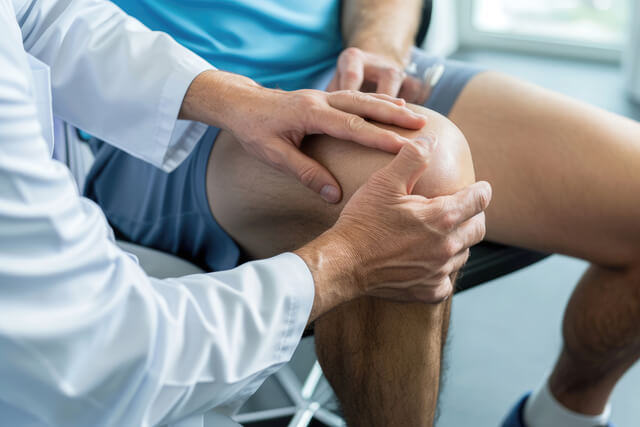
Pinpointing where your knee hurts is a strong start, but an accurate diagnosis still needs a hands-on assessment. A specialist can tell whether pain is coming from a tendon, a meniscus, a ligament or worn cartilage — and which treatment will work best for you.
At Hip & Knee Orthopaedics, assessment usually begins with a detailed history, a physical examination, and imaging such as X-rays or MRI when needed. From there we offer the full spectrum of care — from physiotherapy and injections to keyhole and reconstructive surgery.
For a deeper read on management, see our guide to knee pain causes and treatments, or what to expect with knee pain after physiotherapy.
Treatments for knee & hip pain
Depending on the cause and severity of your pain, treatment may range from evaluation and injections to keyhole or reconstructive surgery.
Knee pain location: FAQ
Can I diagnose my knee pain from its location alone?
Location is a strong clue but not a diagnosis on its own. Many conditions share symptoms, and pain can refer from the hip or shift as you compensate. Use the chart to narrow the possibilities, then confirm with a knee evaluation.
What does pain at the front of my knee usually mean?
Front-of-knee pain that worsens on stairs or after sitting is most often patellofemoral pain syndrome or chondromalacia patellae. In older adults it may be early osteoarthritis. Our anterior knee pain service covers these conditions.
Why does the back of my knee hurt or swell?
A swelling behind the knee is commonly a Baker's cyst, which often develops because of another problem inside the joint such as arthritis or a meniscus tear. Hamstring or calf tendon issues and PCL injuries can also cause posterior pain. Back-of-knee or calf swelling with redness and warmth should be checked urgently to rule out a blood clot.
Is knee pain on the inner side serious?
Inner-knee pain frequently involves the MCL, the medial meniscus or medial-compartment arthritis. It ranges from minor sprains to tears that may need meniscus repair. Persistent pain, locking or a knee that gives way should be assessed.
When should I see an orthopaedic specialist?
See a specialist if pain lasts more than two weeks despite rest, if there's significant swelling or instability, or if you can't bear weight. Seek urgent care for severe pain, deformity, fever, or calf swelling. You can contact us to book an appointment.
Do I always need surgery for knee pain?
No. Most knee pain is managed without surgery — through activity modification, physiotherapy, bracing, bone-health support and injections such as Cingal. Surgery is considered when conservative care hasn't helped or when there is significant structural damage.
Get to the source of your knee pain
Don't suffer in silence. Our experienced knee specialists will identify what's behind your pain and build a personalised plan to get you moving comfortably again.
Schedule an appointment Call +65 8884 1642Medical disclaimer: This article is for general education and is not a substitute for professional medical advice, diagnosis or treatment. Always consult a qualified healthcare provider about your specific condition. Reviewed and approved by Dr Adrian Lau, Orthopaedic Surgeon.