
Reviewed and Approved By Dr Tan Sok Chuen, Orthopaedic Surgeon — MBBS, MRCSEd, MMed (Orth), FRCSEd (Tr & Orth) on 30 July 2026
Published · Last updated
Published · Last updated
If you are preparing for a hip or knee replacement, you may hear your surgeon or physiotherapist mention an "enhanced recovery" or "fast-track" pathway. It is not a marketing phrase. Enhanced Recovery After Surgery, or ERAS, is a specific, evidence-based way of running the whole journey around your operation — before, during and after — so that you recover faster, in less pain, with fewer complications and a shorter hospital stay. This article explains what ERAS is, the evidence behind it, and exactly what happens at each stage of a hip or knee replacement done the ERAS way.ontent here
What is ERAS?
ERAS is a coordinated, multidisciplinary pathway of perioperative care built entirely on evidence. Rather than treating the operation as the single event that matters, ERAS treats recovery as something you actively engineer across the entire perioperative period — from the clinic appointment weeks before surgery to the moment you are safely back on your feet at home.
The idea came from the Danish surgeon Henrik Kehlet, who in 1997 argued that most of what slows patients down after surgery — pain, nausea, grogginess, prolonged bed rest, tubes and drains — is not caused by the surgery itself but by the way care is traditionally delivered. [1] Remove those obstacles one by one, using the best available evidence for each, and the body’s own recovery is far quicker. ERAS began in colorectal surgery and has since been adopted across almost every surgical specialty. [9] For hip and knee replacement, the ERAS Society published a formal consensus guideline in 2020 that pulls the evidence for each element of care into a single protocol. [2]
The unifying principle is simple: reduce the physiological stress of surgery, support the body’s normal functions, and get you moving early. No single component is magic. The benefit comes from doing all of them, consistently, as a team — surgeon, anaesthetist, nurses, physiotherapists and you.
Why ERAS Matters for Hip and Knee Replacement Surgery?
The evidence for ERAS in joint replacement is now substantial, drawn from studies covering hundreds of thousands of patients. Consistently, ERAS pathways:
i) Shorten hospital stay by one to three days without increasing readmissions or complications. [4][5][7] In high-volume centres, average stays have fallen from the old norm of four to ten days down to one to three, and carefully selected patients can now go home the same day. [2]
ii) Reduce opioid use and improve pain control through multimodal, opioid-sparing analgesia — better pain relief with fewer of the side effects that make people feel unwell. [4][6]
iii) Get patients moving sooner — many are standing and walking within hours of surgery rather than the next day. [7]
iv) Lower complication and transfusion rates** and reduce overall cost, largely through shorter stays and fewer problems. [4][5]
v) Produce high patient satisfaction and faster early return of function and quality of life. [4][7]
One systematic review of 24 studies covering more than 216,000 joint-replacement patients found that almost every study reported a shorter hospital stay, most reported lower opioid use or pain, and most reported cost savings — with no increase in readmissions. [4]
One point deserves emphasis because patients understandably worry about it: going home sooner is not the same as being rushed out. The shorter stay is a *consequence* of recovering faster, not the goal in itself, and the evidence shows it happens without more people being readmitted back to hospital. [5]
THE ERAS Pathway, Step by Step
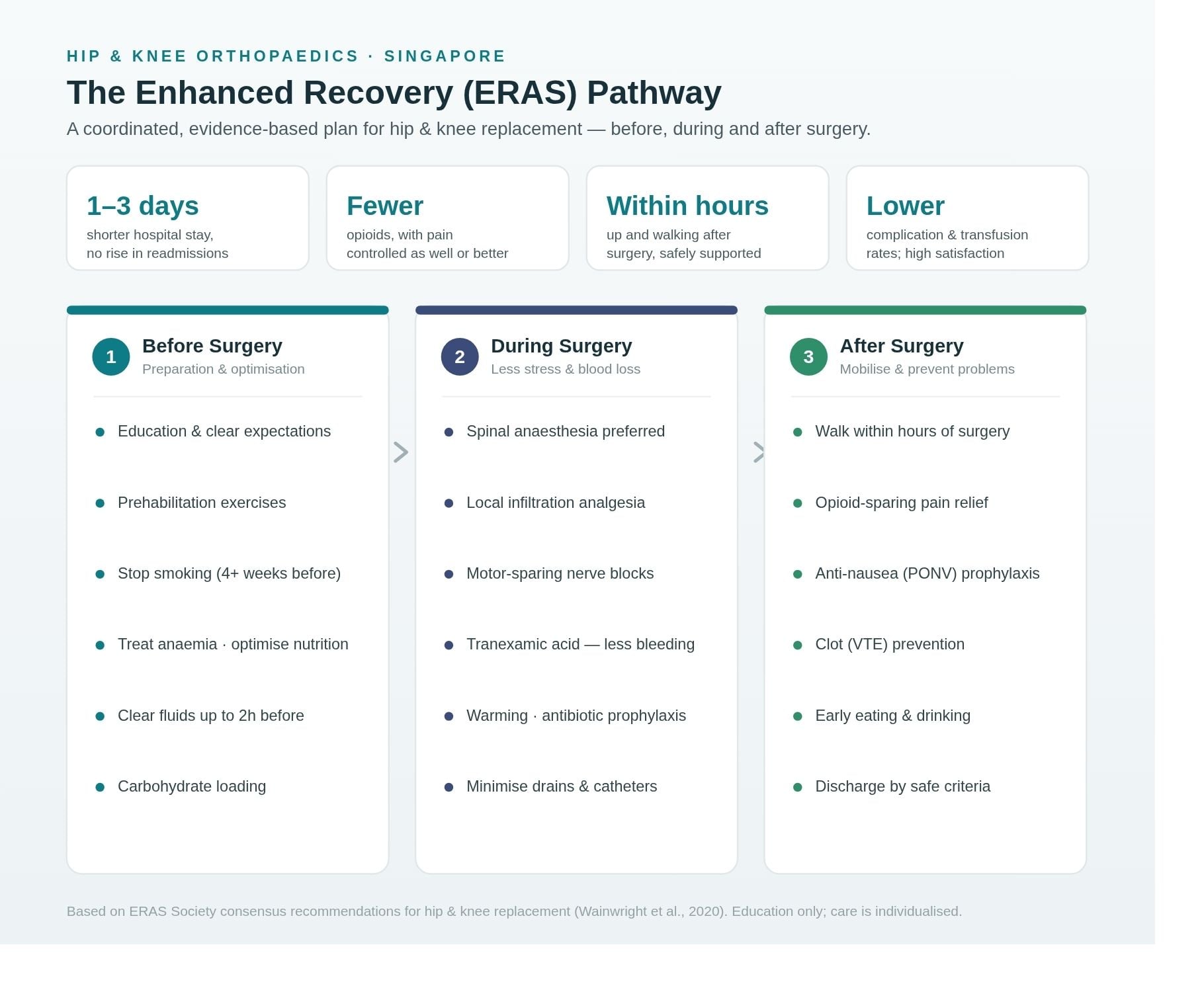
ERAS pathways are organised into three phases: before, during and after surgery. [3] Here is what each involves and the evidence behind it.
Before surgery: preparation and optimisation
1) Education and expectation-setting. You are told, in clear terms, what will happen, what your role is, how pain will be managed, and roughly when you will go home. This is not a formality — good preoperative education reduces anxiety and can improve pain and functional outcomes while smoothing discharge. [3][8] A patient who knows the plan tends to recover better than one who is surprised at every step.
2) Prehabilitation (“prehab”). In the weeks before surgery you may be given a home exercise programme — lower-limb strengthening, flexibility, balance and general aerobic fitness — to go into the operation stronger. The evidence here is modest rather than dramatic (prehab can slightly improve pre-surgery pain and function and trim a little off the hospital stay), but going in fitter rarely hurts and often helps confidence. [7]
3) Medical optimisation. This is where some of the biggest gains hide. Stopping smoking for at least four weeks beforehand lowers the risk of wound and chest complications; reducing alcohol helps too. Treating anaemia before surgery reduces the chance of needing a transfusion. Addressing nutrition, blood sugar and other medical conditions all improve how well you tolerate and recover from the operation. [2][3]
4) Modern fasting and carbohydrate loading. The old rule of “nothing after midnight” is outdated. ERAS allows clear fluids up to two hours before anaesthesia and solid food up to six hours before. Prolonged fasting drives the body into a stressed, catabolic state and worsens insulin resistance; a shorter fast, sometimes with a carbohydrate drink, leaves you better hydrated and metabolically readier for surgery. [2][3]
During surgery: reducing stress and blood loss
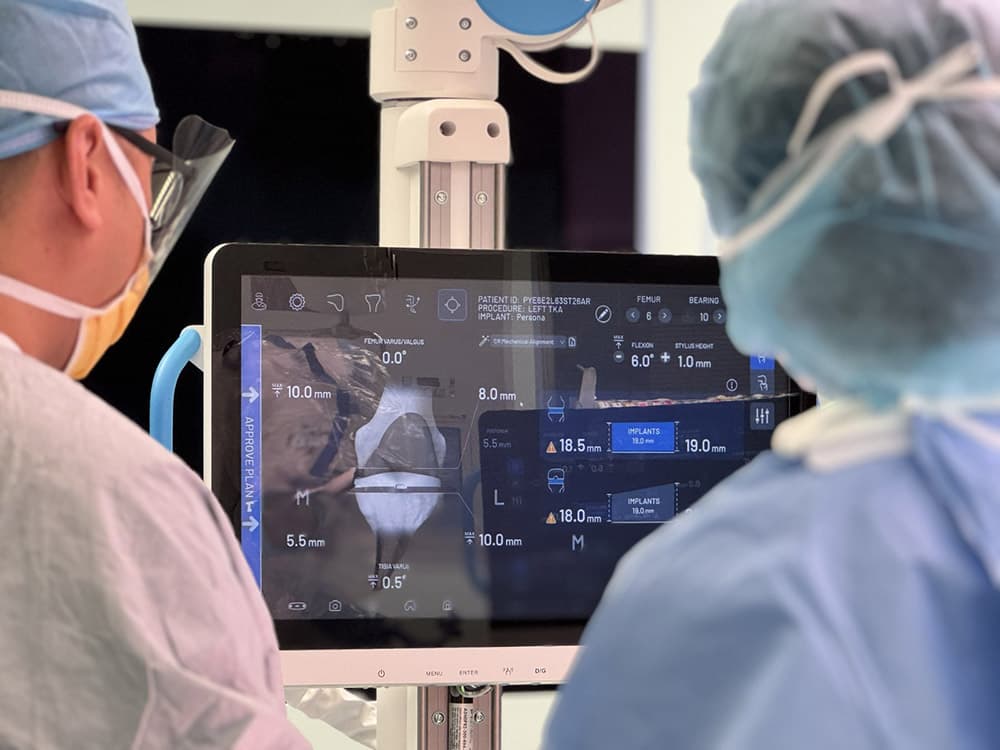
1) Spinal (neuraxial) anaesthesia, where suitable. For hip and knee replacement surgery, spinal anaesthesia is generally preferred over general anaesthesia. It is associated with a smoother recovery and fits the goal of getting patients alert and mobile quickly. [2][3]
2) Opioid-sparing, multimodal pain control starts here. Rather than relying on strong opioids, ERAS layers several pain treatments that work in different ways. Central to knee and hip replacement surgery is **local infiltration analgesia** — the surgeon injects long-acting local anaesthetic directly into the tissues around the joint. It has a key advantage over older nerve blocks: it numbs pain without weakening the muscles, so you can stand and walk sooner. Where a nerve block is used, motor-sparing options are favoured — the adductor canal block for knees and the fascia iliaca or pericapsular (PENG) block for hips — precisely because they control pain while preserving the leg strength you need to mobilise. [3]
3) Tranexamic acid to limit bleeding.This inexpensive drug substantially reduces blood loss and the need for transfusion in hip and knee replacement, and is now a standard part of the pathway. [2][3][10]
4) Keeping you warm, protected and lightly managed. Maintaining normal body temperature reduces bleeding, infection and cardiac strain, so patients are actively warmed. Antibiotics are given to prevent infection. Fluids are managed in a balanced, measured way rather than given liberally. And routine drains and urinary catheters are largely avoided — the evidence shows they usually are not needed and they tether you to the bed. [2][3].
After surgery: mobilise, control pain, prevent problems
1) Early mobilisation. This is the linchpin of the whole pathway. Getting up and walking within hours of surgery — safely, with support — reduces the risks of prolonged bed rest, speeds functional recovery and is only possible because everything upstream (spinal anaesthesia, motor-sparing pain control, no drains or catheters) was designed to make it possible. [2][3]
2) Continued multimodal analgesia. Regular paracetamol and anti-inflammatories form the base, with stronger medication reserved as rescue rather than routine. The aim is a comfortable, clear-headed patient who can do their physiotherapy. [3]
3) Preventing nausea and clots. Anti-sickness medication (such as dexamethasone and/or a 5-HT3 blocker) is given to keep postoperative nausea and vomiting under control, since feeling sick delays eating, drinking and walking. To prevent blood clots (venous thromboembolism), ERAS combines mechanical measures with blood-thinning medication and, crucially, early movement itself. [2][3]
4) Eating, drinking and going home. You return to normal food and drink quickly, and discharge is planned from the start against clear criteria — good pain control, safe mobility, and confidence to manage at home — rather than against a fixed number of nights. [2]
Your Role in ERAS
ERAS only works as a partnership, and several of the highest-value steps are yours to take:
– Stop smoking as early as you can before surgery — ideally at least four weeks. [3]
– Do your prehab exercises and stay as active as your knee or hip allows.
– Optimise your health — follow advice on nutrition, alcohol, blood sugar and any medications.
– Follow the fasting instructions exactly, including any carbohydrate drink — they are designed for your benefit, not just for theatre scheduling.
– Plan to move early. Expect to be up and walking soon after surgery, and treat that as a good sign rather than something to fear.
– Arrange your home — clear trip hazards, sort out help for the first days, and know your follow-up plan before you are admitted.
Frequently asked questions about ERAS
1) Does ERAS mean I will be sent home the same day?
Not necessarily. Same-day or next-day discharge is realistic for many patients on an ERAS pathway, but it depends on your health, your surgery and your recovery on the day. [2] The shorter stay is a result of recovering well, and discharge is based on meeting clear safety criteria — never on the clock alone.
2) Is enhanced recovery safe, or is it cutting corners?
It is the opposite of cutting corners. Every element is evidence-based, and large studies show ERAS shortens stay and reduces opioid use and complications *without* increasing readmissions. [4][5] Getting you moving early and off strong painkillers sooner is safer, not riskier.
3) Will I be in more pain if I am using fewer opioids?
Generally no. Multimodal analgesia often controls pain better than opioids alone, because it tackles pain through several routes at once — and it avoids the grogginess, nausea and constipation that opioids cause and that slow recovery. [3][6]
4) Why will they get me up so soon after surgery?
Because prolonged bed rest is one of the main things that slows recovery and raises the risk of clots and stiffness. The whole pathway — the type of anaesthesia, the pain control, avoiding drains and catheters — is built specifically to make early, safe walking possible. [2][3]
5) Can I still have a general anaesthetic if I prefer, or need one?
Yes. Spinal anaesthesia is generally preferred for joint replacement, but the anaesthetic is always tailored to you. [2] Your anaesthetist will discuss the safest, most suitable option for your health.
5) Does ERAS apply to partial knee replacement too?
Yes. The same principles — optimisation, spinal anaesthesia, opioid-sparing pain control, early mobilisation — apply across hip and knee replacement, and a smaller operation such as a partial knee replacement often fits an enhanced-recovery pathway especially well.
Enhanced Recovery at Hip & Knee Orthopaedics
At Hip & Knee Orthopaedics, we plan every hip and knee replacement around enhanced-recovery principles: preparing and optimising you before surgery, using modern anaesthesia and opioid-sparing pain control during it, and getting you moving safely and early afterwards — coordinated across the surgical, anaesthetic, nursing and physiotherapy team.
In the Singapore setting, this also means practical planning around your hospital stay, financing (MediSave, MediShield Life and Integrated Shield Plans), and a rehabilitation plan you can follow at home. The goal is straightforward: a safe operation, a comfortable recovery, and the fastest realistic return to the things you want to do.
If you are considering a knee or hip replacement, or want to understand what your recovery would actually look like, contact Hip & Knee Orthopaedics to arrange an assessment.
Contact us
References
1. Kehlet H. Multimodal approach to control postoperative pathophysiology and rehabilitation. *British Journal of Anaesthesia.* 1997;78(5):606–617.
2. Wainwright TW, Gill M, McDonald DA, Middleton RG, Reed M, Sahota O, Yates P, Ljungqvist O. Consensus statement for perioperative care in total hip replacement and total knee replacement surgery: Enhanced Recovery After Surgery (ERAS®) Society recommendations. *Acta Orthopaedica.* 2020;91(1):3–19. doi:10.1080/17453674.2019.1683790. https://pubmed.ncbi.nlm.nih.gov/31663402/
3. Riga M, Altsitzioglou P, Saranteas T, Mavrogenis AF. Enhanced recovery after surgery (ERAS) protocols for total joint replacement surgery. *SICOT-J.* 2023;9:E1. https://www.sicot-j.org/articles/sicotj/full_html/2023/01/sicotj230069/sicotj230069.html
4. Changjun C, et al. Enhanced recovery after total joint arthroplasty (TJA): a contemporary systematic review of clinical outcomes and usage of key elements. *Orthopaedic Surgery.* 2023. doi:10.1111/os.13710. https://onlinelibrary.wiley.com/doi/10.1111/os.13710
5. Deng QF, Gu HY, Peng WY, et al. Impact of enhanced recovery after surgery on postoperative recovery after joint arthroplasty: results from a systematic review and meta-analysis. *Postgraduate Medical Journal.* 2018;94(1118):678–693.
6. Zhu S, Qian W, Jiang C, Ye C, Chen X. Enhanced recovery after surgery for hip and knee arthroplasty: a systematic review and meta-analysis. *Postgraduate Medical Journal.* 2017;93(1106):736–742.
7. Enhanced Recovery After Surgery (ERAS) pathways in elective total joint arthroplasty (systematic review). *Cureus.* 2025. https://pmc.ncbi.nlm.nih.gov/articles/PMC12412062/
8. McDonald S, Page MJ, Beringer K, Wasiak J, Sprowson A. Preoperative education for hip or knee replacement. *Cochrane Database of Systematic Reviews.* 2014;(5):CD003526.
9. Ljungqvist O, Scott M, Fearon KC. Enhanced recovery after surgery: a review. *JAMA Surgery.* 2017;152(3):292–298.
10. Fillingham YA, Ramkumar DB, Jevsevar DS, et al. The efficacy of tranexamic acid in total knee arthroplasty: a network meta-analysis. *Journal of Arthroplasty.* 2018;33(10):3090–3098.
11. Kehlet H, Memtsoudis SG. ERAS guidelines for hip and knee replacement — need for reanalysis of evidence and recommendations? *Acta Orthopaedica.* 2020;91(3):243–245.