Hip replacement surgery is a procedure that replaces damaged parts of the hip joint with artificial implants to relieve pain, improve mobility, and restore function. In Singapore, hip replacement is commonly recommended for severe arthritis, hip degeneration, or persistent pain that no longer responds to medication or physiotherapy.
Our comprehensive treatments and additional services are designed to help you regain independence and return to an active lifestyle.
Get your detailed diagnosis in a single visit.
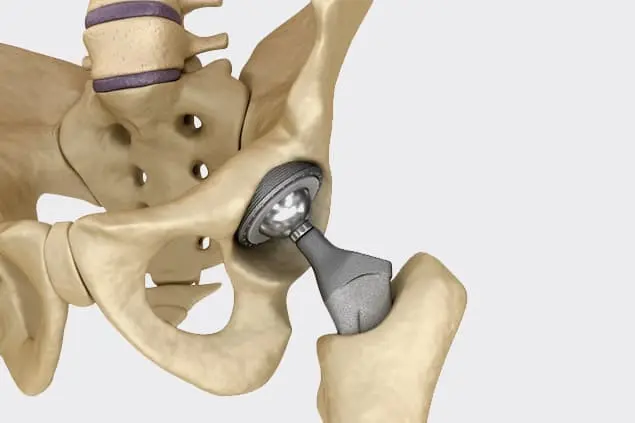
The hip forms a ball-and-socket joint that connects the femoral head (the top of the thigh bone) to the pelvic bone. This structure is one of the body’s largest joints and plays a vital role in everyday movement, from walking and standing to bending and turning.
In this joint, the ball at the top of the femur fits securely into the socket of the pelvis, allowing smooth, controlled movement. The blood supply to the hip is crucial for maintaining healthy bone and tissue, supporting recovery and long-term joint stability.
Hip damage can develop gradually due to wear and tear or occur suddenly after an injury. There are many contributing factors, such as osteoarthritis, rheumatoid arthritis, previous fractures, or repetitive strain on the joint over time. These conditions can cause inflammation and cartilage breakdown, making movement increasingly painful and restricted.
In some cases, a reduction in the blood supply to the femoral head, as seen in avascular necrosis, may lead to bone tissue weakening. The bone then loses its natural strength and smoothness, resulting in stiffness and discomfort when walking or standing.
The use of certain medications, including corticosteroids, and lifestyle factors such as obesity or poor posture, can also contribute to deterioration of the hip joint. In older adults, hip damage is the most common cause of chronic hip pain and a leading reason for hip replacement surgery. Maintaining joint flexibility and muscle strength can help reduce the risk of degeneration and support long-term hip health.
| Conservative Treatment | Hip Replacement |
|---|---|
| Temporary symptom relief | Long-term structural solution |
| Medication and injections | Replaces damaged joint surfaces |
| May become less effective over time | Often improves mobility significantly |
| Suitable for early arthritis | Usually recommended for advanced degeneration |
Hip replacement surgery in Singapore is commonly performed for osteoarthritis associated with ageing, sports injuries, previous trauma, and hip degeneration. Many patients seek treatment when pain begins affecting mobility, work, exercise or independence. Singapore’s ageing population has contributed to increasing demand for hip and knee replacement procedures, especially among active adults seeking to maintain long-term mobility.
Our orthopaedic surgeons guide you through every step of your hip replacement journey. Using minimally invasive surgery techniques such as the direct anterior approach, we preserve healthy tissues and optimise healing.
During the surgical procedure, the damaged parts of the hip joint are removed and replaced with artificial parts like a femur implant or femoral stem, secured in place with or without bone cement.
These carefully engineered components are known as hip prostheses and are designed to mimic the smooth, natural motion of a healthy joint.
Post-surgery, we offer dedicated rehabilitation with your occupational therapist, including walking aid support and custom recovery plans.
Understanding the difference between available procedures can help you make a more informed decision about your treatment. Each approach is suited to specific conditions and patient needs.
Direct anterior hip replacement is a minimally invasive surgical approach that accesses the hip joint from the front of the hip rather than through major muscles at the side or back.
Because the approach works between muscle planes instead of detaching muscles, some patients may experience:
Not every patient is suitable for the anterior approach, and suitability depends on anatomy, body habitus, and the underlying hip condition.
A total hip replacement, also called total hip arthroplasty, involves replacing both the femoral head and the socket of the hip joint with hip implants. This is recommended for conditions like arthritic hip, where joint replacement is necessary due to extensive joint damage.
In a partial hip replacement, only the femoral head is replaced, preserving the natural socket. This is typically recommended for patients with specific types of hip fractures where the socket is still considered healthy.
A revision hip replacement is performed when a previous hip replacement has failed due to factors like implant wear, infection or dislocation. This complex procedure involves replacing or repairing the existing hip prosthesis to restore function.
During the first few weeks, your body begins adapting to the new hip joint as surrounding muscles regain strength and flexibility. You may notice mild swelling around the incision site, which gradually subsides. It is important to follow your rehabilitation plan closely and communicate with your physiotherapist if you are experiencing any discomfort.
Most patients regain independence at the 6-week mark, with full function achievable within several months. Gentle strengthening and stretching exercises help stabilise the hip joint and improve balance as you return to daily activities. They are essential to long-term joint health and overall well-being.
Hip replacement surgery is generally considered when hip pain significantly affects walking, sleep or daily function despite conservative treatment.
Hip replacement surgery is one of the most successful procedures to date, markedly improving pain and mobility for those suffering from severe hip arthritis. The ability to walk better and without pain not only enhances quality of life but also directly benefits physical health by increasing bone density, muscle mass and cardiovascular health. Mental health often improves as well with newfound freedom from hip pain.
You will be placed under either spinal or general anaesthesia for the procedure. The surgeon will begin by making a carefully placed incision and using a muscle-sparing technique to access the hip joint while minimising tissue damage. The damaged cartilage and bone are then removed to expose healthy bone surfaces. Next, the hip prosthesis components are implanted: a specially coated socket is secured in the pelvis, a biocompatible metal stem is inserted into the femur, and the selected bearing surface is positioned. The surgeon then thoroughly checks the stability of the implant and repairs the joint capsule before performing a precise, layered closure of the incision, which is covered with a waterproof dressing.
Blood tests and imaging ensure safety and accuracy. A sterile dressing is applied, and you’re moved to a recovery room.
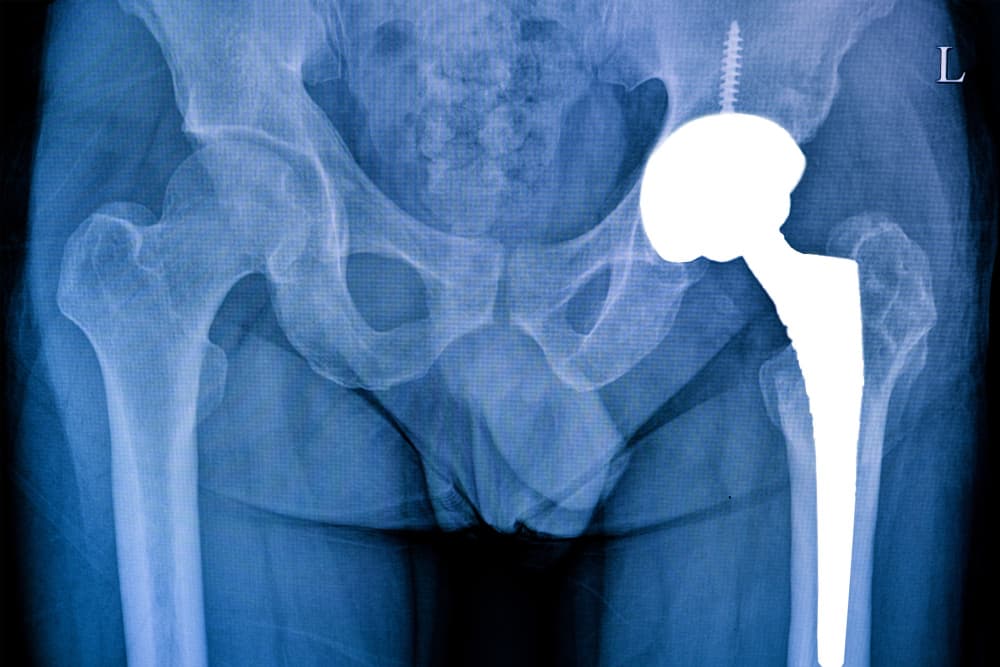
Postoperative X-rays are taken to verify proper implant alignment. Most patients are able to begin walking with the assistance of a walker or quad cane immediately after surgery, marking the first step towards recovery and improved mobility.
After the surgery, you will be asked to come back to the clinic to have your dressings changed every 4-5 days. Dressings are typically removed 2 weeks post-surgery. Twice-weekly physical therapy is highly recommended to strengthen muscles and reduce swelling.
For the first 4 to 6 weeks after surgery, you should avoid certain hip positions and getting up from the floor. Driving is typically permitted after 6 weeks, at which point all hip movement restrictions will be lifted. Full recovery from the surgery usually takes between 3 to 6 months.
• Preoperative Strengthening: Staying active before hip replacement surgery maintains muscle strength, promoting faster recovery.
• Optimise Your Health Before Surgery: Key steps include quitting smoking, achieving a healthy weight before your operation, and maintaining good diabetic control (if applicable).
• Pain Relief and Management: Effective pain control is essential for recovery. Our team, including your anaesthetist, will help manage your pain so you can comfortably participate in prescribed exercises and physical therapy.
• Commit to Physical Therapy: Work closely with your physical therapist and follow your prescribed rehabilitation programme to restore mobility and strength.
• Nutrition and Rest: Eat well-balanced meals and get plenty of rest. Surgery places stress on the body, and pushing yourself too hard can be counterproductive. Listen to your body, as rest and recovery are vital for healing.
• Chronic hip pain and stiffness
• Loss of mobility in daily tasks
• Swelling and reduced range of motion, such as experiencing difficulty lifting your leg
• Conservative treatments are no longer helpful
• Hip pain is reducing your quality of life, resulting in significant lifestyle limitations
• Side effects from hip pain medications
Some surgical pain is typically expected after the procedure. However, our hip replacement surgeons utilise modern techniques to ensure the operation is smooth and effective. Following surgery, you may experience some discomfort in the hip region, thigh or knee. Rest assured, we will work closely with our anaesthetists to effectively manage your pain.
This postoperative discomfort differs from your previous chronic hip pain that limited your lifestyle. Most importantly, this surgical pain will gradually diminish over the coming weeks as you progress through recovery. Maintaining a positive attitude, actively participating in physiotherapy, and setting recovery goals with your surgical team will help keep you on track during your rehabilitation journey.
In most cases, hip replacement surgery takes approximately 2-3 hours, including anaesthesia preparation and reversal. The hospital stay typically averages 2-4 days, depending on the patient’s age, fitness level and the surgical approach used for the hip replacement.
The day after hip replacement surgery, patients usually begin weight-bearing physiotherapy and may require walking aids initially. These aids can typically be gradually discontinued after about 2 weeks, with walking ability improving each week. Participating in regular physiotherapy immediately after hip replacement surgery is crucial for optimal recovery. As muscles strengthen, patients walk more comfortably, experience less pain, and regain mobility.
While some patients may feel strong enough for short outdoor walks by 6 weeks, older or frailer individuals may require up to 3 months to achieve similar milestones. It’s important to discuss your expectations, concerns and recovery goals with your orthopaedic surgeon early on. Remember, your surgical team is committed to helping you achieve the best possible outcome and will make every effort to optimise your recovery.
According to data published on the MOH website, a total hip replacement using SB839H under Table 6A costs approximately $35,000 to $45,000. The surgeon’s fee for the procedure ranges from $8,550 to $12,850. Please refer to the MOH website for details.
Please note that the published data reflect the median of actual transacted fees from 1 July 2019 to 31 December 2020, and there may have been some fee adjustments since then. It is best to discuss this with us directly so we can provide a clearer picture. We can also go over the role and extent of various payers available, such as Hospitalisation Shield plans, corporate group and surgical plans, and Medisave.
Like all surgeries, hip replacement carries potential risks, including blood clots, infection, implant wear, or dislocation. Modern techniques and preventive measures, such as blood thinners, sterile protocols, and precise implant placement, help minimise these risks.
Complication rates are generally low, but individual factors like age and health play a role. Your surgeon will discuss your specific risks and precautions during consultation. Most patients recover without major issues.
We offer affordable and transparent evaluation packages:
Evaluation of Hip Pain with X-ray


Address
38 Irrawaddy Road,
Mount Elizabeth Novena Specialist Centre,
#09-21/38, Singapore 329563
Opening Hours
Monday to Friday: 9 am to 5 pm
Saturday: 9am to 1pm
Closed on Sundays and Public Holidays
Our doctors share their journeys as orthopaedic surgeons as well as offer insights and tips.